


中国区域产业演化的尺度地方化机制
|
毛熙彦(1987—),男,博士,副教授,研究方向为全球化与区域发展、环境经济地理。E-mail: mxy@nju.edu.cn |
收稿日期: 2025-02-06
修回日期: 2025-06-24
网络出版日期: 2025-10-10
基金资助
国家自然科学基金面上项目(42271178)
国家自然科学基金面上项目(42171169)
Rescaling to the Local for the Industrial Evolution in Regions of China
Received date: 2025-02-06
Revised date: 2025-06-24
Online published: 2025-10-10
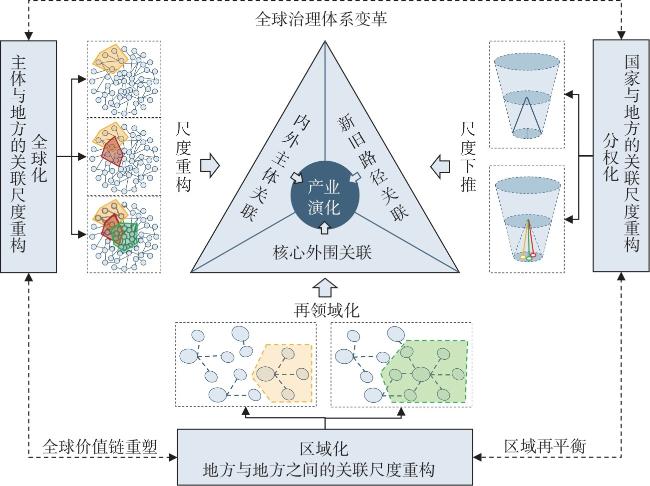
区域产业演化研究通过产业关联的定量实证、路径创造的定性案例,深化过程规律认识,但对区域建构在演化过程中的变化缺少关注,陷入领域性先于关系性的思维定式。文章以历史情境下的区域重构为起点,提出了历史情境—产业关联—路径创造的解析思路,并结合全球化到全球化转型的转变、中国改革开放以来的发展,探讨了区域重构下产业演化的尺度地方化机制。研究发现:①全球化阶段,区域是建立特定经济联系的地方集合,地方从属于不同区域而成为各类经济关联的交汇点。不同关联在地方相互作用并驱动产业演化,地方继而改变区域地位或参与新的区域化,形成区域—地方相互作用的演化进程;②全球化转型阶段,国家是经济治理联系的交汇点,调节超国家与次国家区域之间经济关联,区域产业演化发展为区域—地方驱动与区域—国家调节相结合的演化进程;③中国区域产业演化的尺度地方化过程表现为,在全球化、分权化、区域化特定情境下,在国家通过尺度重构、尺度下推、再领域化等手段调节下,发挥内外主体关联、新旧路径关联、核心外围关联在地方的相互作用,塑造多样化产业演化路径。
毛熙彦 , 贺灿飞 . 中国区域产业演化的尺度地方化机制[J]. 经济地理, 2025 , 45(8) : 114 -121 . DOI: 10.15957/j.cnki.jjdl.2025.08.012
Regional industrial evolution studies mainly include quantitative studies of industrial relatedness studies and qualitative studies of path creation, enriching our understanding of the process of industrial evolution. However, little attention has been paid to the likely changing construction of regions during industrial evolution, which prioritizes territorial thinking of regions over relational thinking. This study proposes a broader context for understanding the regional industrial evolution, that goes beyond the industrial system and the territorial system. This study posits that historical contexts reflect the evolution of social relations that promote the restructuring of regions, change the connections between places, and then promote industrial evolutions. This suggests an analytical logic that follows the interactions between historical context, industrial relatedness, and path creation. On this basis, this paper investigates regional restructuring in two historical contexts, namely the transition from a globalized to a post-globalized world and the development of China since its opening-up and reform. It proposes a rescaling-to-the-local mechanism for regional industrial evolution: 1) During globalization, regions consist of interconnected places. The place can be simultaneously integrated into different regions, so that it faces the interactions of different economic relations. The interaction of economic relations drives its industrial evolution and changes its position within regions. It can also encourage the place to be integrated into new regions. Industrial evolution is therefore driven by the interactions between regions and places. 2) In the post-globalization era, relations of economic governance converge on the nation. The nation plays a key role in moderating economic relations between the supranational and subnational levels. Industrial evolution is thus subject to the promotion of region-place interactions and the moderation of region-nation interactions. 3) The rescaling-to-the-local mechanism in China is embedded in the context of globalization, decentralization, and regionalization. The nation can exercise economic governance by rescaling, downscaling, and re-territorialization. It reshapes the relatedness between local and non-local agents, between new and old paths, and between core and periphery. Their synergy takes a variety of forms and leads to diversified paths.
表1 尺度地方化过程中关联性组合模式及其对产业演化路径的影响Tab.1 Types of relatedness combinations during the rescaling to the local and their effects on path development |
| 路径发展类型 | 尺度地方化过程 | 产业演化方向 | 路径 依赖度 | ||
|---|---|---|---|---|---|
| 内外主体关联 (增量) | 新旧路径关联 (方向) | 核心—外围关联 (突变) | |||
| 路径扩展 | 高 | 高 | 低 | 区域坚持已有的产业基础,进一步扩大优势 | 高 ↓ 低 |
| 路径提质 | 高 | 高 | 高 | 区域在巩固已有产业基础的条件下,进一步拓展产业链,实现升级 | |
| 路径增效 | 高 | 低 | 低 | 区域凭借相关多样化优势,推动产业集群化发展 | |
| 路径引进 | 高 | 低 | 高 | 区域凭借区位优势,通过导入外部资源,引进新发展路径 | |
| 路径分叉 | 低 | 高 | 低 | 区域凭借已有产业基础发展关联新产业 | |
| 路径多样化 | 低 | 高 | 高 | 区域在现有路径基础上,引入不相关资源,推动多元化发展 | |
| 路径创造 | 低 | 低 | 高 | 区域捕捉区位机会窗口,导入全新的外部资源,探索新发展路径 | |
| [1] |
许吉黎, 张虹鸥, 陈奕嘉, 等. 演化经济地理学的理论脉络演进与研究议题展望[J]. 地理研究, 2023, 42(9):2433-2450.
|
| [2] |
赵建吉, 王艳华, 苗长虹. 区域新兴产业形成机理:演化经济地理学的视角[J]. 经济地理, 2019, 39(6):36-45.
|
| [3] |
|
| [4] |
|
| [5] |
|
| [6] |
|
| [7] |
|
| [8] |
朱晟君, 杨博飞, 刘逸. 经济全球化变革下的世界经济地理与中国角色[J]. 地理学报, 2022, 77(2):315-330.
|
| [9] |
陈品宇, 李鲁奇, 孔翔. 社会建构主义视角下的区域:研究综述与启示[J]. 人文地理, 2019(6):10-61.
|
| [10] |
刘云刚, 张吉星, 王丰龙. 粤港澳大湾区协同发展中的尺度陷阱[J]. 地理科学进展, 2022, 41(9):1677-1687.
|
| [11] |
|
| [12] |
贺灿飞, 朱晟君. 中国产业发展与布局的关联法则[J]. 地理学报, 2020, 75(12):2684-2698.
|
| [13] |
|
| [14] |
|
| [15] |
郭琪, 朱晟君. 市场相似性与中国制造业出口市场的空间演化路径[J]. 地理研究, 2018, 37(7):1377-1390.
|
| [16] |
|
| [17] |
|
| [18] |
|
| [19] |
毛熙彦, 贺灿飞. 经济全球化新叙事与中国经济地理学发展新趋势[J]. 地理学报, 2023, 78(12):2905-2921.
|
| [20] |
|
| [21] |
刘晗玥, 毛熙彦, 桂镜玄, 等. 低碳技术产品国际贸易的区域化特征及其对碳减排的影响[J]. 地理研究, 2025, 44(1):36-56.
|
| [22] |
|
| [23] |
|
| [24] |
毛熙彦, 贺灿飞. 区域发展的“全球—地方”互动机制研究[J]. 地理科学进展, 2019, 38(10):1449-1461.
|
| [25] |
许吉黎, 叶玉瑶, 罗子昕, 等. 新发展格局下粤港澳大湾区高科技产业多尺度空间联系与政策启示[J]. 地理科学进展, 2022, 41(9):1592-1605.
|
| [26] |
|
| [27] |
|
| [28] |
贺灿飞, 王文宇, 郭琪. 中国工业地理学的传承发展与转型[J]. 地理学报, 2021, 76(8):1815-1834.
|
| [29] |
|
| [30] |
|
| [31] |
王东京. 中国经济体制改革的理论逻辑与实践逻辑[J]. 管理世界, 2018 (4):1-7.
|
| [32] |
|
| [33] |
王文宇, 贺灿飞, 陈新明. 贸易壁垒、贸易协定与中国制造业出口网络演化[J]. 经济地理, 2021, 41(11):118-128.
|
| [34] |
伏怡铭, 刘振, 李伟. 中国市域新产业类型演化与地区经济发展阶段[J]. 经济地理, 2025, 45(4):232-243.
|
| [35] |
胡晓辉, 林潭晨, 接栋正, 等. 特殊类型地区新产业路径发展研究综述[J]. 资源科学, 2024, 46(10):2009-2021.
|
/
| 〈 |
|
〉 |