


文旅产业双向共聚对区域经济发展的影响——以东北三省为例
|
马丽君(1981—),男,博士,教授,博士生导师,研究方向为旅游地理。E-mail:ljmaljly@163.com |
收稿日期: 2024-12-27
修回日期: 2025-09-27
网络出版日期: 2025-11-20
基金资助
国家社会科学基金项目(24BGL130)
湖南省社会科学基金项目(24ZDAJ022)
Impact of Bidirectional Coagglomeration of Cultural and Tourism Industries on Regional Economic Development: A Case Study of 36 Prefecture-Level Cities in Northeast China
Received date: 2024-12-27
Revised date: 2025-09-27
Online published: 2025-11-20
马丽君 , 欧阳旻 . 文旅产业双向共聚对区域经济发展的影响——以东北三省为例[J]. 经济地理, 2025 , 45(10) : 245 -255 . DOI: 10.15957/j.cnki.jjdl.2025.10.025
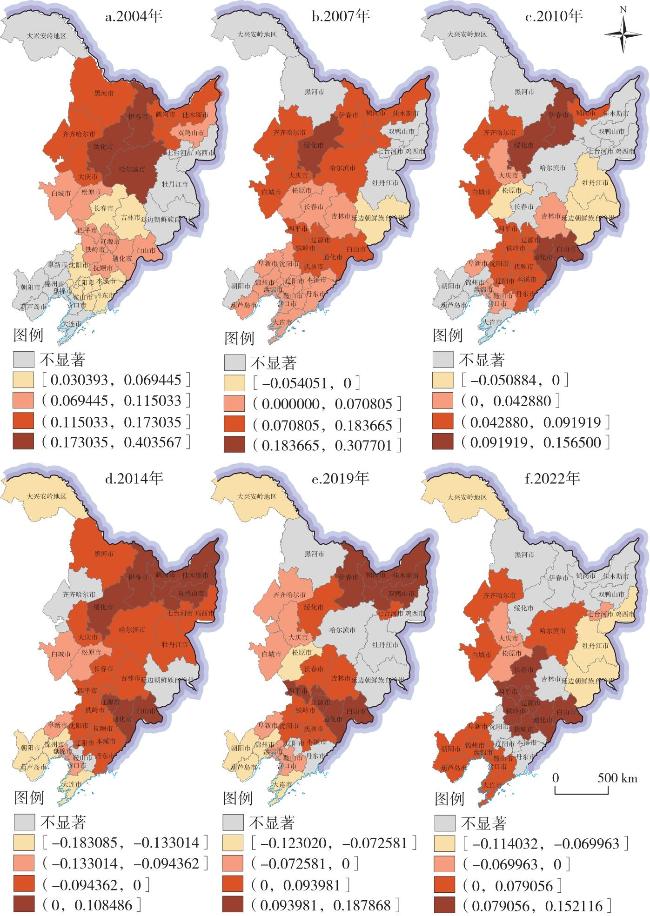
The bidirectional coagglomeration of the cultural and tourism industries (CTI) reflects the asymmetric spatial relationship between the two industries, serving as a crucial spatial manifestation of their integration and holding significant value for the revitalization and development of Northeast China. Using data of cultural and tourism enterprises from 36 prefecture-level cities in Northeast China between 2004 and 2022, this study explores the impact mechanism of CTI bidirectional coagglomeration on economic development, calculates the CTI bidirectional coagglomeration index, and analyzes its effects on economic development. The findings indicate that: 1) The coagglomeration of the tourism industry into the cultural industry is stronger than vice versa. During the sample period, the overall level of CTI bidirectional coagglomeration remained relatively stable, with cities experiencing faster improvement mainly concentrated in economically advanced areas such as Shenyang, Dalian, Anshan, Changchun, and Harbin. 2) Global OLS regression results show that CTI bidirectional coagglomeration significantly promotes economic development, with the coagglomeration of the cultural industry into the tourism industry exerting the strongest positive effect. 3) Local Geographically and Temporally Weighted Regression results reveal that the impact of CTI bidirectional coagglomeration on economic development exhibits spatiotemporal heterogeneity, initially positive in 2004 but turning negative by 2022, indicating diseconomies of CTI bidirectional coagglomeration in Northeast China. The results provide a theoretical basis for promoting CTI bidirectional coagglomeration to foster economic development and deepen the study of the relationship between CTI bidirectional coagglomeration and economic development.
表1 文化产业、旅游产业与国民经济行业分类对应关系Tab.1 Correspondence between the cultural industry,tourism industry,and national economic sector classifications |
| 产业名称 | 产业大类 | 对应国民经济行业的产业中类分类代码(部分) |
|---|---|---|
| 文化产业 | 新闻信息服务、内容创作生产、创意设计服务、文化传播渠道、文化投资运营、文化娱乐休闲服务 | 243工艺美术及礼仪用品制造,307陶瓷制品制造,514文化、体育用品及器材批发,518贸易经纪与代理,524文化、体育用品及器材专门零售,631电信,632广播电视传输服务,633卫星传输服务,等 |
| 旅游产业 | 旅游出行、旅游住宿、旅游餐饮、旅游游览、旅游购物、旅游娱乐、旅游综合服务 | 014蔬菜、食用菌及园艺作物种植,521综合零售,523纺织、服装及日用品专门零售,531铁路旅客运输,533铁路运输辅助活动,541城市公共交通运输,542公路旅客运输,551水上旅客运输,等 |
表2 全局OLS回归的估计结果Tab.2 Estimation results from global OLS regression |
| 变量 | (1) ln y1 | (2) ln y1 | (3) ln y1 | (4) ln y1 | (5) ln y1 | (6) ln y1 |
|---|---|---|---|---|---|---|
| x1 | 0.033** | 0.038** | ||||
| x2 | 0.085*** | |||||
| x3 | 0.012 | |||||
| ln x4 | 0.150*** | 0.164*** | 0.237*** | 0.252*** | 0.284*** | 0.240*** |
| ln x5 | 0.215*** | 0.207*** | 0.298*** | 0.288*** | 0.275*** | 0.295*** |
| x6 | -0.188*** | -0.199*** | -0.165*** | -0.177*** | -0.190*** | -0.168*** |
| ln x7 | 0.180*** | 0.197*** | 0.231*** | 0.250*** | 0.273*** | 0.236*** |
| ln x8 | 0.311*** | 0.306*** | ||||
| ln x9 | 0.237*** | 0.230*** | 0.242*** | 0.234*** | 0.222*** | 0.239*** |
| ln x10 | 0.113*** | 0.112*** | 0.145*** | 0.144*** | 0.147*** | 0.144*** |
| ln x11 | -0.159*** | -0.155*** | -0.047* | -0.044* | -0.050** | -0.045* |
注:***、**、*分别表示在1%、5%、10%水平上显著;为节省版面,标准误差不显示。 |
表3 文旅产业双向共聚对经济发展影响的GTWR模型回归系数的统计结果Tab.3 Statistical results of GTWR model regression coefficients for the impact of CTI bidirectional coagglomeration on economic development |
| 变量 | (4) | ||||
|---|---|---|---|---|---|
| 显著回归 系数占比(%) | 平均值 | 中位数 | >0的回归 系数占比(%) | 变异系数 | |
| x1 | 79.39 | 0.0439 | 0.0562 | 71.45 | 1.9350 |
| ln x4 | 96.35 | 0.2734 | 0.2816 | 99.09 | 0.4681 |
| ln x5 | 90.50 | 0.2579 | 0.2580 | 97.25 | 0.4602 |
| x6 | 90.79 | -0.1822 | -0.1725 | 0.32 | -0.5245 |
| ln x7 | 89.47 | 0.2256 | 0.2377 | 87.91 | 0.7558 |
| ln x9 | 90.50 | 0.2291 | 0.2100 | 99.19 | 0.5855 |
| ln x10 | 95.03 | 0.1804 | 0.2052 | 91.08 | 0.6730 |
| ln x11 | 70.47 | 0.1274 | 0.1141 | 88.17 | 0.9907 |
注:表中“显著回归系数占比”列统计所有回归系数,显著回归系数指P≤0.1的系数;其余列只统计显著回归系数。 |
| [1] |
习近平. 高举中国特色社会主义伟大旗帜为全面建设社会主义现代化国家而团结奋斗——在中国共产党第二十次全国代表大会上的报告[J]. 党建, 2022(11):4-28.
|
| [2] |
徐菲菲, 剌利青, 严星雨, 等. 中国文化产业与旅游产业融合研究述评[J]. 旅游科学, 2023, 37(4):1-18.
|
| [3] |
田川. 文旅融合:让诗与远方实现更好联结[N]. 社会科学报,2024-11-14(01).
|
| [4] |
杨懿, 廉倩文, 丁玲, 等. 国家级夜间文旅消费集聚区空间分布特征及影响因素[J]. 经济地理, 2023, 43(6):202-210.
|
| [5] |
王玲, 李悦晴. 城市群视域下我国物流业与制造业双向共聚水平的测度及其空间特征[J]. 经济地理, 2023, 43(5):128-138.
|
| [6] |
周霖, 唐承财, 周成, 等. 国家级夜间文化和旅游消费集聚区空间结构特征与驱动机制[J]. 干旱区资源与环境, 2024, 38(1):171-179.
|
| [7] |
陈露, 刘修岩. 产业空间共聚、知识溢出与创新绩效——兼议区域产业多样化集群建设路径[J]. 经济研究, 2024, 59(4):78-95.
|
| [8] |
孙浦阳, 韩帅, 许启钦. 产业集聚对劳动生产率的动态影响[J]. 世界经济, 2013, 36(3):33-53.
|
| [9] |
刘月, 邹苗苗, 陈建军. 空间经济学视角下的产业协同集聚:一个文献综述[J]. 江淮论坛, 2017(3):47-53,193.
|
| [10] |
陈露, 刘修岩, 叶信岳, 等. 城市群视角下的产业共聚与产业空间治理:机器学习算法的测度[J]. 中国工业经济, 2020(5):99-117.
|
| [11] |
钟韵, 秦嫣然. 高质量发展视角下产业协同集聚研究进展[J]. 人文地理, 2023, 38(4):1-8,120.
|
| [12] |
余煌, 杨子璇, 张景秋. 文化产业集聚对中国城市经济转型影响的空间效应与作用机制研究[J]. 地理研究, 2024, 43(6):1388-1406.
|
| [13] |
麻学锋, 赵洁. 旅游产业集聚对民生福利的影响研究——以湘西地区为例[J]. 地理科学进展, 2023, 42(8):1486-1500.
|
| [14] |
曹晋湘, 方永恒. 文旅产业协同集聚对经济高质量发展的影响研究——以黄河流域地级市为例[J]. 资源开发与市场, 2025, 41(5):720-730.
|
| [15] |
周圣强, 朱卫平. 产业集聚一定能带来经济效率吗:规模效应与拥挤效应[J]. 产业经济研究, 2013(3):12-22.
|
| [16] |
舒伯阳, 郭海荣. 文旅深度融合中的创意与科技双轨协同机制[J]. 中南民族大学学报(人文社会科学版), 2024, 44(6):149-157,187.
|
| [17] |
黄大勇, 谢正发. 乌江风情廊道文化旅游产业集群发展研究[J]. 南通大学学报(社会科学版), 2018, 34(6):29-34.
|
| [18] |
明庆忠, 史鹏飞, 韩剑磊. 旅游全产业链:内涵、逻辑与构建[J]. 学术探索, 2023(1):83-93.
|
| [19] |
廖成林, 王渝. 供应链协调:我国古城镇旅游供给侧改革的新视角[J]. 经济体制改革, 2017(2):43-49.
|
| [20] |
王西贝, 王群勇. 产业协同集聚对区域经济增长的影响研究——基于规模效应与拥堵效应视角[J]. 经济评论, 2023(2):43-58.
|
| [21] |
朱纪广, 李小建. 产业集聚对区域经济高质量增长的影响效应——基于空间溢出效应视角[J]. 经济地理, 2022, 42(10):1-9.
|
| [22] |
|
| [23] |
马立强. 海洋文化旅游休闲产业竞争优势构建:产业集聚的视角[J]. 东南大学学报(哲学社会科学版), 2015, 17(6):84-91,147.
|
| [24] |
陈亮. 产业集聚影响下区域科技创新效率的集聚效应与拥挤效应——基于北上广深面板数据的实证分析[J]. 科技管理研究, 2023, 43(19):173-183.
|
| [25] |
吴黎围, 熊正贤. 区块链视域下康养休闲特色小镇同质化问题及破解——以云贵川地区为例[J]. 湖北民族大学学报(哲学社会科学版), 2020, 38(3):64-72.
|
| [26] |
杨懿, 时蓓蓓, 刘小迪. 旅游经济依赖背景下区域经济脆弱性评价研究——以张家界市、阿坝州、丽江市为例[J]. 财经理论与实践, 2019, 40(5):128-135.
|
| [27] |
王心蕊, 黄丹丹, 李毓. 廊道旅游地空间网络结构及其形成机制[J]. 经济地理, 2025, 45(1):236-245.
|
| [28] |
刘少和, 梁明珠. 环大珠三角城市群游憩带旅游产业集聚发展路径模式——以广东山海旅游产业园区建设为例[J]. 经济地理, 2015, 35(6):190-197.
|
| [29] |
李宛聪, 李红, 王士君, 等. 东北地区收缩城市识别及其建设用地扩张时空演变[J]. 资源科学, 2024, 46(2):368-385.
|
| [30] |
张可云, 朱春筱. 中国工业结对集聚和空间关联性分析[J]. 地理学报, 2021, 76(4):1019-1033.
|
| [31] |
|
| [32] |
廉晓梅, 姜姿卉. 东北地区经济联系的空间格局演变及影响因素分析[J]. 城市问题, 2024(4):42-51.
|
| [33] |
张学波, 于伟, 张亚利, 等. 京津冀地区经济增长的时空分异与影响因素[J]. 地理学报, 2018, 73(10):1985-2000.
|
| [34] |
李岫儒, 柴娇, 马连骄, 等. 东北冰雪运动产业发展的文化生态阐释:内涵、困境与方略[J]. 沈阳体育学院学报, 2020, 39(6):102-107.
|
| [35] |
朱志胜, 李朋波, 常雯. 东北旅游协同发展的困境与突破:动能转换视角[J]. 旅游学刊, 2023, 38(5):8-10.
|
| [36] |
冯兴华, 修春亮, 刘志敏, 等. 东北地区城市网络层级演变特征分析——基于铁路客运流视角[J]. 地理科学, 2018, 38(9):1430-1438.
|
/
| 〈 |
|
〉 |