


京津冀城市群生态绩效水平测度及影响因素
|
孟雪(1993—),女,黑龙江绥芬河人,博士研究生。主要研究方向为经济地理。E-mail:mx6510@163.com。 |
收稿日期: 2019-01-27
修回日期: 2019-06-14
网络出版日期: 2025-04-25
基金资助
国家自然科学基金项目(41571127)
教育部人文社科重点研究基地重大项目(17JJD790010)
Measurement on the Level of the Urban Ecological Performance and Analysis of Influential Factors in Beijing-Tianjin-Hebei Urban Agglomeration
Received date: 2019-01-27
Revised date: 2019-06-14
Online published: 2025-04-25
孟雪 , 狄乾斌 , 季建文 . 京津冀城市群生态绩效水平测度及影响因素[J]. 经济地理, 2020 , 40(1) : 181 -186 . DOI: 10.15957/j.cnki.jjdl.2020.01.020
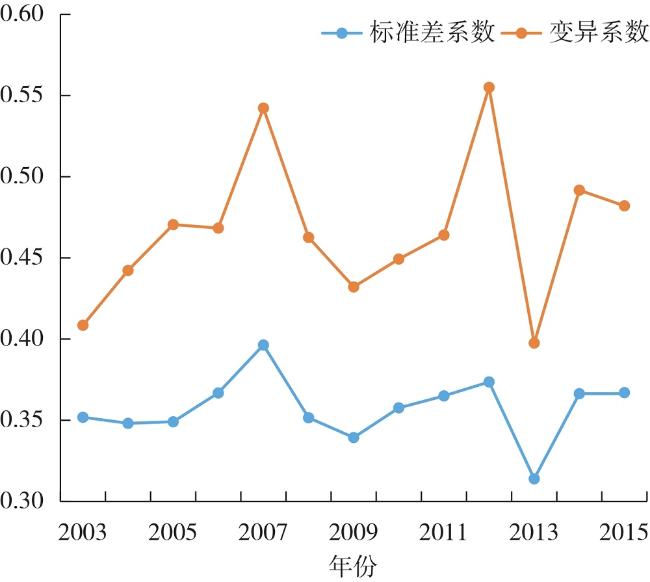
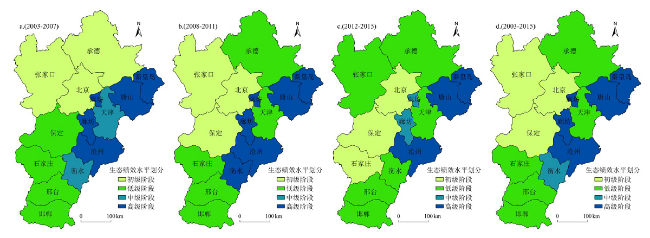
Based on the perspective of cyclic economy, ecological performance level and spatiotemporal difference feature of Beijing-Tianjin-Hebei area including 13 cities are measured using SBM super-efficiency model from 2003 to 2015. Meanwhile, panel Tobit and random effect model are applied to regression analysis of the influence factors of ecological performance. The conclusions are as follows: 1) Cangzhou and Tangshan keep on the production frontiers during the period of study consistently and Beijing, Shijiazhuang are further beneath the production frontiers, having a large room for improving urban ecological performance. 2) Fluctuation of absolute difference change and relative difference change is large with consistent trend of change and transparent feature of periodic change. Difference takes on an amplified trend in recent two years. Districts with a higher level of ecological performance of Beijing-Tianjin-Hebei area distribute closely to coastal areas predominantly, which has obvious difference between regions. 3) Regression analysis shows that low carbon potential, air quality and regional economic development have positive impact on the level of ecological performance, and the estimation coefficient of opening-up level is negative and significant; population pressure is a potential factor to hinder the improvement of ecological performance level.
表1 城市生态绩效评价指标体系Tab.1 The index system of urban ecological performance evaluation |
| 指标类别 | 指标构成 | |
|---|---|---|
| 投入 | 资本消耗 | 固定资本存量(万元) |
| 土地资源消耗 | 建成区面积(hm2) | |
| 劳动力消耗 | 年末单位从业人员(万人) | |
| 水资源消耗 | 供水总量(万m3) | |
| 能源资源消耗 | 能源消耗总量(万吨标准煤) | |
| 科技(信息)消耗 | 财政科学支出(元) | |
| 国际互联网用户数(户) | ||
| 固定电话用户(万家) | ||
| 移动电话用户(万家) | ||
| 产出 | 经济效益产出 | GDP(万元) |
| 循环利用产出 | 城市水重复利用率(%) 一般工业固体废物综合利用率(%) | |
表2 京津冀地区各市部分生态绩效值及排名Tab.2 The value and ranking of partial ecological performance in each city of Beijing-Tianjin-Hebei |
| 城市 | 2003 | 2007 | 2011 | 2015 | 平均值 | ||||||||
|---|---|---|---|---|---|---|---|---|---|---|---|---|---|
| 效率值 | 排名 | 效率值 | 排名 | 效率值 | 排名 | 效率值 | 排名 | ||||||
| 北京市 | 0.469 | 11 | 0.523 | 8 | 0.124 | 13 | 0.160 | 13 | 0.320 | ||||
| 天津市 | 0.888 | 8 | 0.704 | 6 | 0.607 | 9 | 0.702 | 6 | 0.730 | ||||
| 石家庄市 | 0.596 | 10 | 0.446 | 9 | 0.485 | 10 | 0.359 | 12 | 0.500 | ||||
| 唐山市 | 1.340 | 1 | 1.270 | 2 | 1.315 | 2 | 1.222 | 2 | 1.308 | ||||
| 秦皇岛市 | 1.007 | 6 | 1.014 | 5 | 1.021 | 4 | 0.713 | 5 | 0.973 | ||||
| 邯郸市 | 0.651 | 9 | 0.539 | 7 | 0.633 | 6 | 0.592 | 8 | 0.608 | ||||
| 邢台市 | 1.029 | 4 | 0.376 | 11 | 0.625 | 8 | 1.002 | 4 | 0.659 | ||||
| 保定市 | 1.014 | 5 | 0.393 | 10 | 0.371 | 12 | 0.450 | 10 | 0.480 | ||||
| 张家口市 | 0.325 | 12 | 0.349 | 12 | 0.470 | 11 | 0.513 | 9 | 0.432 | ||||
| 承德市 | 0.261 | 13 | 0.213 | 13 | 0.631 | 7 | 0.596 | 7 | 0.522 | ||||
| 沧州市 | 1.202 | 3 | 1.459 | 1 | 1.321 | 1 | 1.279 | 1 | 1.303 | ||||
| 廊坊市 | 1.275 | 2 | 1.048 | 3 | 1.011 | 5 | 1.118 | 3 | 1.051 | ||||
| 衡水市 | 1.002 | 7 | 1.036 | 4 | 1.038 | 3 | 0.388 | 11 | 0.909 | ||||
表3 京津冀城市地区生态绩效影响因素回归结果Tab.3 The regression results of the influential factors of ecological performancein Beijing-Tianjin-Hebei |
| 解释变量 | 代表指标 | 模型 | |
|---|---|---|---|
| Tobit | RE | ||
| 人口压力(Y1) | 人口密度(人/km2) | -0.0704(-1.12) | -0.0944*(-2.27) |
| 低碳潜能(Y2) | 公共汽(电)车客运总数占地区总人口比重(次/人) | 0.172*(1.69) | 0.102*(-2.18) |
| 政府执行力(Y3) | 政府财政支出占GDP比重(%) | 0.0124(0.14) | 0.00707(-0.13) |
| 对外开放水平(Y4) | 外商直接投资额占GDP比重(%) | -0.0878*(-1.82) | -0.0266*(-1.85) |
| 空气质量(Y5) | 全年空气质量达到和好于Ⅱ级天数占比(%) | 1.504***(8.81) | 0.574***(9.41) |
| 地区经济发展状况(Y6) | 人均GDP(元/人) | 0.734***(3.31) | 0.348**(3.26) |
| 地区随机 | YES | YES | |
| 年份随机 | YES | YES | |
注:括号里面的数值是Z值;***、**、*分别代表1%、5%和10%的显著水平。 |
| [1] |
方创琳. 中国城市群研究取得的重要进展与未来发展方向[J]. 地理学报, 2014, 69(8):1130-1 144.
|
| [2] |
陆大道. 京津冀城市群功能定位及协同发展[J]. 地理科学进展, 2015, 34(3):265-270.
|
| [3] |
刘睿文, 封志明, 杨艳昭, 等. 基于人口集聚度的中国人口集疏格局[J]. 地理科学进展, 2010, 29(10):1171-1 177.
|
| [4] |
胡志强, 苗健铭, 苗长虹. 中国地市尺度工业污染的集聚特征与影响因素[J]. 地理研究, 2016, 35(8):1470-1 482.
|
| [5] |
陈璇, 淳伟德. 环境绩效、环境信息披露与经济绩效相关性研究综述[J]. 软科学, 2010, 24(6):137-140.
|
| [6] |
|
| [7] |
|
| [8] |
ISO. ISO 14031:Environmental performance evaluation Guidelines[R]. Geneva:ISO, 1999:5-10.
|
| [9] |
何平林, 石亚东, 李涛. 环境绩效的数据包络分析方法——项基于我国火力发电厂的案例研究[J]. 会计研究, 2012(2):11-17.
|
| [10] |
林立国, 楼国强. 外资企业环境绩效的探讨——以上海市为例[J]. 经济学(季刊), 2014, 13(2):515-536.
|
| [11] |
杨霞, 王乐娟. 环境绩效与财务绩效关系区域比较研究——来自重污染行业上市公司的实证数据[J]. 人文地理, 2016, 31(5):155-160.
|
| [12] |
张子龙, 逯承鹏, 陈兴鹏, 等. 中国城市环境绩效及其影响因素分析:基于超效率DEA模型和面板回归分析[J]. 干旱区资源与环境, 2015, 29(6):1-7.
|
| [13] |
陈晓红, 周智玉. 基于规模报酬可变假设的城市环境绩效评价及其成因分解[J]. 中国软科学, 2014(10):121-128.
|
| [14] |
吕斌, 曹娜. 中国城市空间形态的环境绩效评价[J]. 城市发展研究, 2011, 18(7):38-46.
|
| [15] |
盖美, 连冬, 田成诗, 等. 辽宁省环境效率及其时空分异[J]. 地理研究, 2014, 33(12):2345-2 357.
|
| [16] |
程钰, 任建兰, 陈延斌, 等. 中国环境规制效率空间格局动态演变及其驱动机制[J]. 地理研究, 2016, 35(1):123-136.
|
| [17] |
|
| [18] |
|
| [19] |
郭嵘. 基于生态绩效评价的哈尔滨生态城市建设对策研究[C]//中国城市规划学会、沈阳市人民政府. 规划60年:成就与挑战——2016中国城市规划年会论文集(07城市生态规划). 中国城市规划学会、沈阳市人民政府, 2016:9.
|
| [20] |
|
| [21] |
宫大鹏, 赵涛, 慈兆程, 等. 基于超效率SBM的中国省际工业化石能源效率评价及影响因素分析[J]. 环境科学学报, 2015, 35(2):585-595.
|
| [22] |
蔡晓春, 肖小爱. 基于超效率DEA的中国区域能源利用效率研究[J]. 统计与信息论坛, 2010, 25(4):33-40.
|
| [23] |
成刚. 数据包络分析方法与MaxDEA软件[M]. 北京: 知识产权出版社, 2014:152.
|
| [24] |
杨肃昌, 马素琳. 空气质量与城市发展——基于动态面板GMM模型的实证分析[J]. 经济问题探索, 2015(8):52-60.
|
| [25] |
徐成龙, 任建兰, 程钰. 山东省环境规制效率时空格局演变及影响因素[J]. 经济地理, 2014, 34(12):35-40.
|
| [26] |
王颖芳, 张彦芝. 基于生态供需关系下的“有限规划”理念的现实性初探[J]. 城市发展研究, 2011, 18(7):87-94.
|
| [27] |
陈凯, 邓婷. 环境态度、引导用语与绿色出行意向研究[J]. 干旱区资源与环境, 2017, 31(3):191-196.
|
| [28] |
郑周胜, 黄慧婷. 地方政府行为与环境污染的空间面板分析[J]. 统计与信息论坛, 2011, 26(10):52-57.
|
| [29] |
余长林, 杨惠珍. 分权体制下中国地方政府支出对环境污染的影响——基于中国287个城市数据的实证分析[J]. 财政研究, 2016(7):46-58.
|
/
| 〈 |
|
〉 |