


东部产业为何难以向中西部转移——基于人力资本空间差异的解释
|
严立刚(1985—),男,湖南邵阳人,博士研究生,讲师。主要研究方向为文化产业学。E-mail:491829121@qq.com。 |
收稿日期: 2019-08-27
修回日期: 2019-11-01
网络出版日期: 2025-04-25
基金资助
湖南省教育厅优秀青年项目(19B198)
Why Eastern Industry is Difficult to Transfer to Midwest: An Explanation Based on the Spatial Difference of Human Capital
Received date: 2019-08-27
Revised date: 2019-11-01
Online published: 2025-04-25
人力资本对产业的空间分布具有决定性作用,由于人力资本空间分布的差异性,导致不同地区的产业集聚能力高低有别。因此,从人力资本空间差异视角研究人力资本与产业空间转移的关系,可以为我国东部产业难以向中西部转移的原因和收效甚微的区域协调发展政策提供一种理论解释。基于城市层面数据的实证分析表明,人力资本份额增加能够有效促进地区产业份额增加,在解决了人力资本与产业空间分布的反向因果关系后,人力资本促进产业集聚的作用仍然稳健。在人力资本仍集聚于东部地区的情况下,东部制造业和文化产业自然难以向中西部地区转移。中西部地区应将人力资本政策作为产业政策的核心部分,提高中西部地区人力资本存量,是促进产业向中西部地区转移的有效应对之策。
严立刚 , 曾小明 . 东部产业为何难以向中西部转移——基于人力资本空间差异的解释[J]. 经济地理, 2020 , 40(1) : 125 -131 . DOI: 10.15957/j.cnki.jjdl.2020.01.014
Human capital plays a decisive role in the spatial distribution of industry. Because of the difference in the spatial distribution of human capital, the industrial agglomeration ability of different regions is different. Therefore, studying the relationship between human capital and industrial spatial transfer from the perspective of spatial difference of human capital can provide a theoretical explanation for the reasons why the eastern industry is difficult to transfer to the central or western regions and the policy of regional coordinated development with little effect. Empirical analysis based on urban data shows that the increase of human capital share can effectively promote the increase of regional industrial share. After solving the reverse causal relationship between human capital and industrial spatial distribution, the role of human capital in promoting industrial agglomeration remains stable. While human capital is still concentrated in the eastern region, the eastern manufacturing and cultural industries are naturally difficult to transfer to the central and Western regions. The central and western regions should regard the human capital policy as the core part of the industrial policy. Improving the human capital stock in the central and western regions is an effective countermeasure to promote the industrial transfer to the central and Western regions.
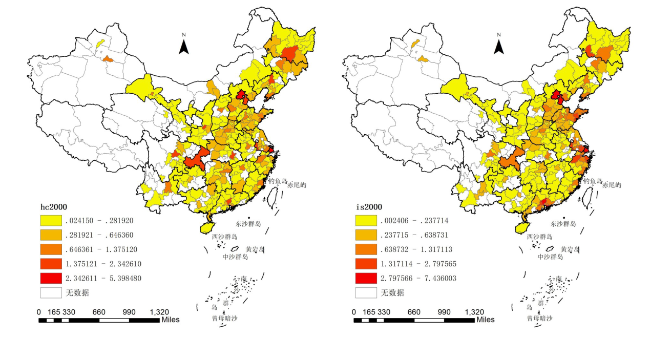
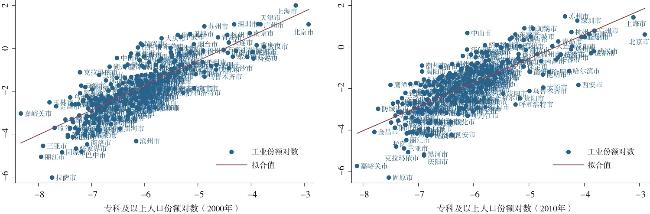
图3 2000年城市人力资本(左)和产业(右)的空间分布Fig.3 Spatial distribution of urban human capital (left) and industry (right) in 2000 |
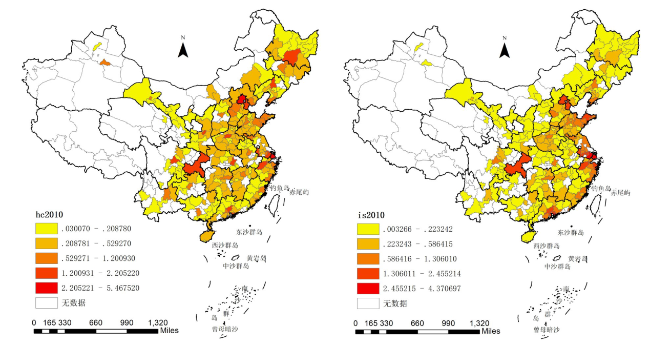
图4 2010年城市人力资本(左)和产业(右)的空间分布Fig.4 Spatial distribution of urban human capital (left) and industry (right) in 2010 |
表1 人力资本与产业空间分布回归结果Tab.1 The return result of human capital and industrial spatial distribution |
| (1)OLS | (2)OLS | (3)OLS | (4)Ⅳ | |
|---|---|---|---|---|
| ln人力资本份额 | 1.1846*** (0.0147) | 0.4049*** (0.0119) | 0.3585*** (0.0126) | 0.3701*** (0.0157) |
| ln行业多样化 | 0.2697*** (0.0090) | 0.1874*** (0.0094) | 0.1841*** (0.0094) | |
| ln行业专业化 | 0.3571*** (0.0105) | 0.4519*** (0.0115) | 0.4587*** (0.0118) | |
| ln行业税率 | -0.1767*** (0.0128) | -0.1721*** (0.0135) | -0.1716*** (0.0135) | |
| ln行业基础设施 | 0.5541*** (0.0074) | 0.4848*** (0.0082) | 0.4800*** (0.0085) | |
| ln到最近港口距离 | -0.1910*** (0.0104) | -0.1886*** (0.0104) | ||
| ln工资水平 | 0.1497*** (0.0420) | 0.1537*** (0.0428) | ||
| ln迁移成本 | -0.0060 (0.0126) | -0.0028 (0.0127) | ||
| ln贸易自由度 | -0.1183*** (0.0151) | -0.1324*** (0.0154) | ||
| ln开放度 | 0.0497*** (0.0067) | 0.0497*** (0.0068) | ||
| ln运输基础设施 | 0.1603*** (0.0174) | 0.1659*** (0.0175) | ||
| 年份虚拟变量 | 已控制 | 已控制 | 已控制 | 已控制 |
| 行业虚拟变量 | 已控制 | 已控制 | 已控制 | 已控制 |
| 常数项 | 6.5722*** (0.1521) | -7.7692*** (0.1864) | -6.8268*** (0.4806) | -6.7966*** (0.5237) |
| N | 17 962 | 17 123 | 14 977 | 14 913 |
| R2 | 0.504 | 0.864 | 0.872 | 0.872 |
注:括号内为标准误差;***代表10%的显著性水平。 |
表2 工具变量第一阶段回归结果Tab.2 First-stage regression results of instrumental variables |
| 被解释变量 | |
|---|---|
| ln人力资本份额对数 | Ⅳ |
| 工具变量:ln(1990年人力资本份额×城市高等学校数) | 0.4964*** |
| 其他解释变量 | 已控制 |
| 样本量 | 14 913 |
| R2 | 0.8052 |
| 不可识别检验p值 | 0.000 |
| Hausman检验χ2值 | 58.59 |
| P值 | 0.029 |
| 工具变量F值 | 22 000 |
注:***代表10%的显著性水平。 |
| [1] |
庞娟. 产业转移与区域经济协调发展[J]. 理论与改革, 2000(3):81-82.
|
| [2] |
胡俊超. 区域经济协调发展的路径依赖[J]. 特区经济, 2006(6):286-288.
|
| [3] |
郑鑫, 陈耀. 运输费用、需求分布与产业转移——基于区位论的模型分析[J]. 中国工业经济, 2012(2):57-67.
|
| [4] |
刘友金, 曾小明. 中国工业空间格局的演变与集聚差异——基于EDSA和城市面板数据的空间计量研究[J]. 区域经济评论, 2016(1):80-88.
|
| [5] |
刘嗣明, 童欢, 徐慧. 中国区际产业转移的困境寻源与对策探究[J]. 经济评论, 2007(6):133-139.
|
| [6] |
陈秀山, 徐瑛. 中国制造业空间结构变动及其对区域分工的影响[J]. 经济研究, 2008(10):104-116.
|
| [7] |
李娅, 伏润民. 为什么东部产业不向西部转移:基于空间经济理论的解释[J]. 世界经济, 2010(8):59-71.
|
| [8] |
赵伟, 张萃. 市场一体化与中国制造业区域集聚变化趋势研究[J]. 数量经济技术经济研究, 2009(2):18-32.
|
| [9] |
陈建军. 中国现阶段产业区域转移的实证研究——结合浙江105家企业的问卷调查报告的分析[J]. 管理世界, 2002(6):64-74.
|
| [10] |
王永培, 袁平红. 工资差异、劳动力流动与工业集聚——基于新经济地理学的解释和实证检验[J]. 财经科学, 2010(3):53-60.
|
| [11] |
谢丽霜. 东部资本规模西进的障碍[J]. 生产力研究, 2005(11):135-137.
|
| [12] |
贺胜兵, 刘友金, 周华蓉. 沿海产业为何难以向中西部地区转移——基于企业网络招聘工资地区差异的解析[J]. 中国软科学, 2012(1):160-169.
|
| [13] |
陈国生, 张亨溢, 赵立平, 等. 比较优势和竞争优势对地区制造业转移的影响[J]. 经济地理, 2018, 38(9):168-175.
|
| [14] |
郭丽. 产业区域转移粘性分析[J]. 经济地理, 2009, 29(3):395-398.
|
| [15] |
|
| [16] |
金煜, 陈钊, 陆铭. 中国的地区工业集聚:经济地理、新经济地理与经济政策[J]. 经济研究, 2006(4):79-89.
|
| [17] |
胡安俊, 孙久文. 中国制造业转移的机制、次序与空间模式[J]. 经济学(季刊), 2014(4): 1 533-1 556.
|
| [18] |
洪俊杰, 刘志强, 黄薇. 区域振兴战略与中国工业空间结构变动——对中国工业企业调查数据的实证分析[J]. 经济研究, 2014(8):28-40.
|
| [19] |
|
| [20] |
薄文广. 产业特征、空间差异与制造业地理集中:基于中国数据的实证分析[J]. 南方经济, 2010(6):51-64.
|
| [21] |
夏怡然, 陆铭. 城市间的“孟母三迁”——公共服务影响劳动力流向的经验研究[J]. 管理世界, 2015(10):78-90.
|
| [22] |
|
| [23] |
张文武, 梁琦. 劳动地理集中、产业空间与地区收入差距[J]. 经济学(季刊), 2011(2):691-708.
|
/
| 〈 |
|
〉 |