


“集聚—扩散”视角下中国区域创新极及其知识溢出区位
|
王腾飞(1990—),男,山东巨野人,博士研究生,研究方向为知识经济与区域发展。E-mail:wangtenfei_1991@163.com |
收稿日期: 2020-08-25
修回日期: 2021-04-20
网络出版日期: 2025-04-17
基金资助
国家自然科学基金面上项目(41771174)
华东师范大学未来科学家和优秀学者培育计划(WLKXJ202009)
Regional Innovation Pole and Its Location of Knowledge Spillovers in China from the Perspective of “Agglomeration-diffusion”
Received date: 2020-08-25
Revised date: 2021-04-20
Online published: 2025-04-17
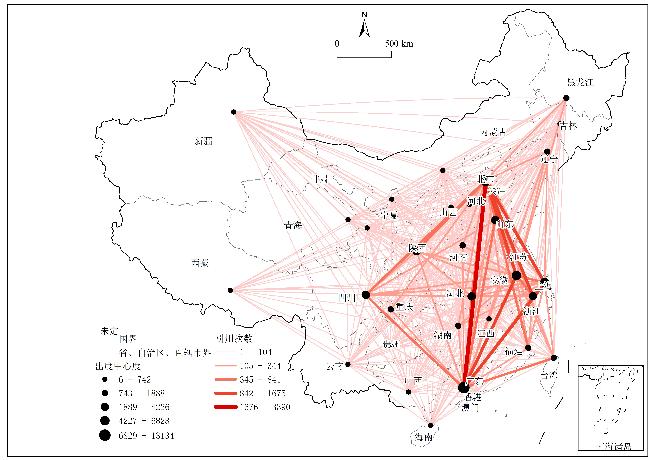
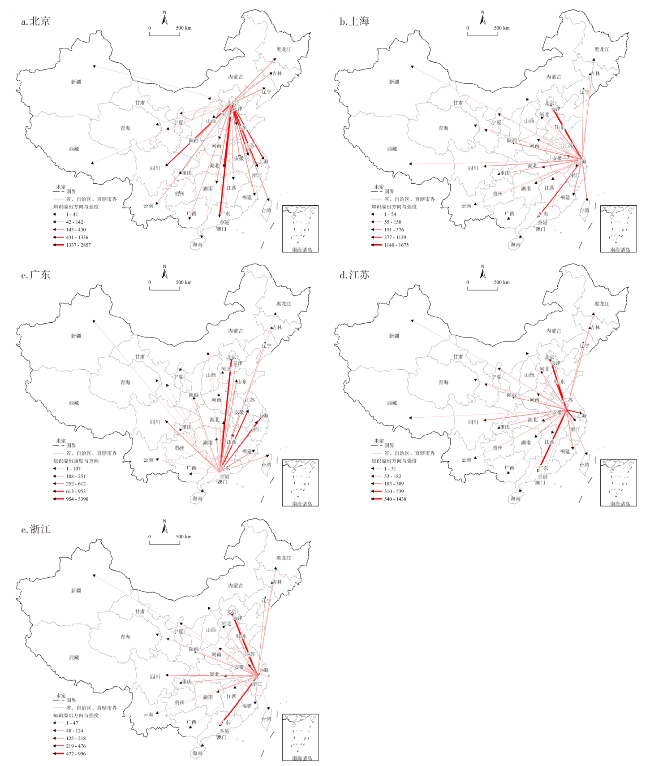
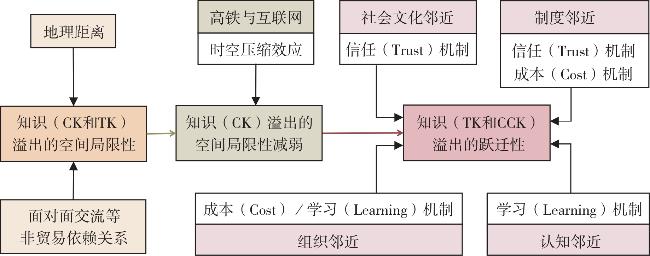
集聚经济发展的后期阶段,技术扩散与知识溢出对区域协同创新和均衡发展愈加重要。基于“集聚—扩散”视角构建包括数据包络分析和社会网络分析在内的区域创新极识别方法,运用ArcGIS软件刻画知识溢出区位特征,并基于人文与经济地理学理论构建解释框架。研究发现:①北京、上海和广东已发育为区域创新极,且北京的创新能极最高,而江苏和浙江已发育成次区域创新极;②中国区域知识溢出网络已形成以“北京—上海—广东”为顶点的密集三角形区域,以及以“北京—四川—广东”为顶点的次密集三角形区域;③中国区域创新极知识溢出的区位呈现出明显的地方根植性和空间跃迁性特征,且基本遵循“信任—学习—成本”三维机制驱动的人文与经济地理学解释框架。
王腾飞 , 谷人旭 , 马仁锋 , 朱雯美 , 苏心怡 . “集聚—扩散”视角下中国区域创新极及其知识溢出区位[J]. 经济地理, 2021 , 41(5) : 11 -18 . DOI: 10.15957/j.cnki.jjdl.2021.05.002
According to the theory of economic geography,the regional innovation driving development mainly goes through two stages: the agglomeration of innovation elements and the diffusion of knowledge and technology. In the advanced stage,the regional "center" and "periphery" form an innovation field under the effect of agglomeration and diffusion,and the innovation pole is a force field in which the convergence force and diffusion force coexist. In the late stage of the development of agglomeration economy,technology diffusion and knowledge spillover are more and more important to the regional equilibrium and synergy innovation. Based on the "agglomeration-diffusion" dual perspective,this paper constructs a regional innovation pole identification method including data envelopment analysis and social network analysis,and uses ArcGIS software to describe the spatial trajectory characteristics of knowledge spillover. And based on the theory of human and economic geography,this paper explains the location characteristics. The results show that: 1) Beijing,Shanghai and Guangdong have developed into regional innovation poles in China,and Beijing has the highest innovation capability,while Jiangsu and Zhejiang have developed into sub regional innovation poles. 2) regional knowledge spillover networks of China have formed a dense triangle area with "Beijing-Shanghai-Guangdong" as its apex,and a sub dense triangle area with "Beijing-Sichuan-Guangdong" as its apex. 3) The spatial trajectory of knowledge spillover of regional innovation poles in China shows obvious characteristics of local embeddedness and spatial jump,while the distance attenuation effect of knowledge spillover is not obvious. And it follows the explanation framework driven by the three-dimensional mechanism of "trust-learning-cost". The results are helpful to provide policy basis for the endogenous growth path driven by knowledge spillover and the regional high-quality integration development in China.
表1 区域创新集聚能力测度的指标体系与说明Tab.1 Index system and explanation of regional innovation agglomeration capacity measurement |
| 创新集聚能力 | 一级指标 | 二级指标 | 三级指标 | 指标说明 |
|---|---|---|---|---|
| 创新势能 | 创新效率 | 创新投入指标 | R&D人员全时当量 | 反映创新人才要素投入 |
| R&D经费内部支出 | 反映创新资本要素投入 | |||
| 创新产出指标 | 专利授权量 | 反映创新活动的直接知识产出 | ||
| SCI\EI\CPCI-S发文量 | 反映创新活动的直接知识产出 | |||
| 新产品产值 | 反映创新活动的间接经济效益 | |||
| 技术市场成交合同额 | 反映创新活动的间接经济效益 | |||
| 其它指标 | 就业人数 | 测度比较人才投入率的中间变量 | ||
| GDP | 测度比较资本投入率的中间变量 | |||
| 创新投入 | 创新投入指标 | R&D人员全时当量 | 反映区域创新存量水平 | |
| R&D经费内部支出 |
数据来源:《中国科技统计年鉴2017》《中国统计年鉴2017》。 |
表2 2016年中国各省创新势能测度结果Tab.2 Results of innovation potential energy of provinces in China |
| 省区 | IGR | 省区 | IGR | 省区 | IGR | ||
|---|---|---|---|---|---|---|---|
| 北京 | 5.23 | 四川 | 0.60 | 广西 | 0.14 | ||
| 上海 | 3.07 | 福建 | 0.57 | 贵州 | 0.11 | ||
| 天津 | 2.67 | 辽宁 | 0.43 | 青海 | 0.08 | ||
| 浙江 | 2.18 | 吉林 | 0.42 | 内蒙古 | 0.08 | ||
| 广东 | 1.87 | 黑龙江 | 0.38 | 海南 | 0.07 | ||
| 江苏 | 1.57 | 甘肃 | 0.33 | 新疆 | 0.07 | ||
| 安徽 | 1.15 | 河南 | 0.33 | 西藏 | 0.01 | ||
| 山东 | 1.04 | 河北 | 0.30 | 台湾 | 数据缺失 | ||
| 陕西 | 1.00 | 江西 | 0.20 | 香港 | 数据缺失 | ||
| 湖北 | 0.93 | 宁夏 | 0.18 | 澳门 | 数据缺失 | ||
| 湖南 | 0.76 | 山西 | 0.16 | ||||
| 重庆 | 0.64 | 云南 | 0.14 |
表3 2016年中国各省知识溢出网络出度中心度Tab.3 Centrality of knowledge spillover networks in provinces of China |
| 省区 | ECR | 省区 | ECR | 省区 | ECR | ||
|---|---|---|---|---|---|---|---|
| 北京 | 13 134 | 湖南 | 1 510 | 贵州 | 256 | ||
| 广东 | 10 272 | 安徽 | 1 494 | 甘肃 | 244 | ||
| 江苏 | 6 828 | 辽宁 | 1 411 | 内蒙古 | 203 | ||
| 上海 | 6 636 | 黑龙江 | 1 125 | 新疆 | 189 | ||
| 浙江 | 4 226 | 河南 | 1 108 | 海南 | 178 | ||
| 山东 | 3 393 | 重庆 | 982 | 香港 | 142 | ||
| 湖北 | 2 933 | 河北 | 742 | 宁夏 | 100 | ||
| 四川 | 2 873 | 吉林 | 611 | 青海 | 69 | ||
| 陕西 | 2 371 | 广西 | 582 | 西藏 | 24 | ||
| 福建 | 1 888 | 江西 | 516 | 澳门 | 6 | ||
| 天津 | 1 769 | 云南 | 459 | ||||
| 台湾 | 1 603 | 山西 | 350 |
表4 2016年中国区域创新极识别结果Tab.4 Results of regional innovation poles in China |
| 省区 | IPR | 省区 | IPR | 省区 | IPR | ||
|---|---|---|---|---|---|---|---|
| 北京 | 68 658 | 福建 | 1 076 | 贵州 | 30 | ||
| 上海 | 20 394 | 重庆 | 628 | 宁夏 | 18 | ||
| 广东 | 19 194 | 辽宁 | 606 | 内蒙古 | 16 | ||
| 江苏 | 10 749 | 黑龙江 | 422 | 海南 | 13 | ||
| 浙江 | 9 224 | 河南 | 363 | 新疆 | 12 | ||
| 天津 | 4 716 | 吉林 | 256 | 青海 | 6 | ||
| 山东 | 3 528 | 河北 | 223 | 西藏 | 0 | ||
| 湖北 | 2 730 | 江西 | 104 | 台湾 | 数据缺失 | ||
| 陕西 | 2 366 | 甘肃 | 81 | 香港 | 数据缺失 | ||
| 四川 | 1 720 | 广西 | 80 | 澳门 | 数据缺失 | ||
| 安徽 | 1 720 | 云南 | 65 | ||||
| 湖南 | 1 151 | 山西 | 55 |
| [1] |
殷德生, 吴虹仪, 金桩. 创新网络、知识溢出与高质量一体化发展[J]. 上海经济研究, 2019(11):30-45.
|
| [2] |
白俊红, 王钺, 蒋伏心, 等. 研发要素流动,空间知识溢出与经济增长[J]. 经济研究, 2017(7):109-123.
|
| [3] |
王腾飞, 谷人旭, 马仁锋. 知识溢出研究的“空间性”转向及人文与经济地理学议题[J]. 经济地理, 2020, 40(6):55-67.
|
| [4] |
|
| [5] |
尹虹潘, 刘姝伶. “中心—亚中心—外围”区域发展格局:宏观战略与微观诉求的空间联结[J]. 改革, 2020(12):67-83.
|
| [6] |
王蓓, 刘卫东, 陆大道. 中国大都市区科技资源配置效率研究[J]. 地理科学进展, 2011, 30(10):1233-1239.
|
| [7] |
王承云, 孙飞翔. 长三角城市创新空间的集聚与溢出效应[J]. 地理研究, 2017, 36(6):1042-1052.
|
| [8] |
马静, 邓宏兵, 张红. 空间知识溢出视角下中国城市创新产出空间格局[J]. 经济地理, 2018, 38(9):96-104.
|
| [9] |
马海涛. 基于知识流动的中国城市网络研究进展与展望[J]. 经济地理, 2016, 36(11):207-213,223.
|
| [10] |
|
| [11] |
|
| [12] |
|
| [13] |
马海涛. 知识流动空间的城市关系建构与创新网络模拟[J]. 地理学报, 2020, 75(28):708-721.
|
| [14] |
段德忠, 杜德斌, 谌颖, 等. 中国城市创新技术转移格局与影响因素[J]. 地理学报, 2018, 73(4):738-754.
|
| [15] |
王腾飞, 马仁锋. 长三角地区城市创新关联及其隐性壁垒研究[J]. 上海经济研究, 2019(12):45-55.
|
| [16] |
李丹丹, 汪涛, 魏也华, 等. 中国城市尺度科学知识网络与技术知识网络结构的时空复杂性[J]. 地理研究, 2015, 34(3):525-540.
|
| [17] |
刘承良, 桂钦昌, 段德忠, 等. 全球科研论文合作网络的结构异质性及其邻近性机理[J]. 地理学报, 2017, 72(4):737-752.
|
| [18] |
|
| [19] |
林建浩, 赵子乐. 均衡发展的隐形壁垒:方言、制度与技术扩散[J]. 经济研究, 2017(9):184-199.
|
| [20] |
毛琦梁, 王菲. 地区比较优势演化的空间关联:知识扩散的作用与证据[J]. 中国工业经济, 2018(11):136-154.
|
| [21] |
|
| [22] |
高丽娜, 蒋伏心. 创新要素集聚与扩散的经济增长效应分析[J]. 南京社会科学, 2011(10):30-36.
|
| [23] |
杜德斌, 何舜辉. 全球科技创新中心的内涵、功能与组织结构[J]. 中国科技论坛, 2016(2):10-15.
|
| [24] |
|
| [25] |
|
| [26] |
李琳, 雒道政. 多维邻近性与创新:西方研究回顾与展望[J]. 经济地理, 2013, 33(6):1-7,41.
|
| [27] |
|
| [28] |
仵凤清, 高利岩, 陈飞宇. 京津冀科技梯度测度研究[J]. 企业经济, 2013(2):171-176.
|
| [29] |
|
| [30] |
陶长琪, 彭永樟. 制度邻近下知识势能对区域技术创新效率的空间溢出效应[J]. 当代财经, 2018(2):15-25.
|
| [31] |
曾赛星, 陈宏权, 金治州, 等. 重大工程创新生态系统演化及创新力提升[J]. 管理世界, 2019(4):28-38.
|
| [32] |
王腾飞, 谷人旭, 姜炎鹏, 等. 长江三角洲城市创新梯度研究[J]. 经济问题探索, 2019(7):78-84.
|
| [33] |
|
| [34] |
|
| [35] |
周灿, 曾刚, 尚勇敏. 演化经济地理学视角下创新网络研究进展与展望[J]. 经济地理, 2019, 39(5):29-38.
|
| [36] |
|
/
| 〈 |
|
〉 |