


中国县域农民工市民化质量的测度与差异分解
|
孟凡强(1982—),男,博士,副研究员,硕士生导师,研究方向为劳动经济。E-mail:fanqiangmeng@126.com |
收稿日期: 2023-04-21
修回日期: 2023-11-16
网络出版日期: 2024-06-03
基金资助
全国统计科学研究项目优选(一般)项目(2022LY053)
广东省自然科学基金面上项目(2024A1515012314)
广东省哲学社会科学规划项目(GD23XZZC16)
广东省研究生教育创新计划资助项目(2023JGXM_065)
Measurement and Disparity Decomposition of the Citizenization Quality of Migrant Workers in Counties of China
Received date: 2023-04-21
Revised date: 2023-11-16
Online published: 2024-06-03
孟凡强 , 彭志勇 , 陈亮均 . 中国县域农民工市民化质量的测度与差异分解[J]. 经济地理, 2024 , 44(2) : 52 -60 . DOI: 10.15957/j.cnki.jjdl.2024.02.006
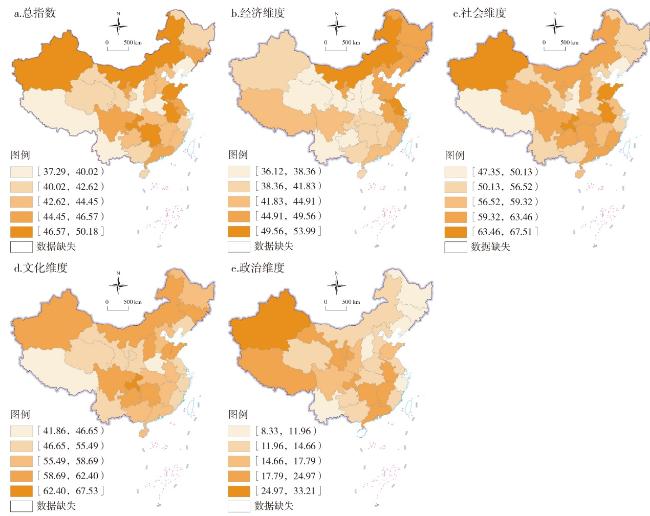
Enhancing the citizenization quality of migrant workers in counties is an important part of county urbanization construction. Based on the data of China Migrant Population Dynamic Monitoring Survey,the article constructs a comprehensive evaluation index system from four dimensions,namely economic,social,cultural and political,measures the citizenization quality of migrant workers in counties by adopting the grade-by-grade equal-weighted average method,analyzes the results of the measurement by adopting the unconditional quantile regression method,and explores the factors influencing the difference in the citizenization quality of migrant workers in counties and those in non-county areas from the perspective of the group. The results show that: 1) The citizenization quality of migrant workers is lower in county of China,showing a spatial distribution pattern of high in the east of China and low in the west of China,and the citizenization quality of migrant workers is lower in county areas than that in non-county areas. 2) From the decomposition of differences,the difference between the citizenization quality of county and non-county migrant workers is mainly caused by regional discrimination,which is mainly manifested in the gap in the rate of return to education,and the rate of return to education of non-county migrant workers is much higher than that of county migrant workers. 3) The county and non-county differences in the citizenization quality of migrant workers increase with the increase of the quartile,but the regional discrimination caused by the difference in coefficients is getting weaker and weaker.
表1 县域农民工市民化质量评价指标及说明Tab.1 Indicators and descriptions of the citizenization quality evaluation of county migrant workers |
| 一级指标 | 二级指标 | 三级指标 | 指标说明及取值 |
|---|---|---|---|
| 经济维度 | 就业 | 工作稳定性 | 分级1~5,有固定期限合同为5,无固定期限为4,一次性合同为3,试用期为2,无劳动合同为1 |
| 就业身份 | 雇主与有固定雇主的雇员赋值为1,自营劳动者与无固定雇主赋值为0 | ||
| 职业状况 | 分级1~5,白领为5,商业服务为4,生活服务为3,蓝领为2,无固定职业者为1 | ||
| 就业单位性质 | 分级1~4,国企和外企为4,股份/联营企业和私企为3,个体和无单位为2,其他为1 | ||
| 收入与消费 | 收入 | 高于全国城镇居民平均收入赋值为1,低于平均赋值为0 | |
| 消费 | 高于全国城镇居民平均支出赋值为1,低于平均赋值为0 | ||
| 住房 | 住房性质 | 购房赋值为3,租房赋值为2,无房赋值为1 | |
| 社会维度 | 社会保障 | 医疗保障 | 有职工险或者公费医疗赋值为1,没有赋值为0 |
| 养老保障 | 有养老保险赋值为1,没有赋值为0 | ||
| 公共健康服务 | 居民健康档案 | 已建立居民健康档案赋值为1,没有赋值为0 | |
| 健康教育 | 接受过健康教育赋值为1,没有赋值为0 | ||
| 社会融合 | 我很愿意融入本地 | 分级1~4,完全不同意为1,不同意为2,基本同意为3,完全同意为4 | |
| 我觉得本地人愿意接受 | 分级1~4,完全不同意为1,不同意为2,基本同意为3,完全同意为4 | ||
| 我感觉本地人看不起外地人 | 分级1~4,完全同意为1,基本同意为2,不同意为3,完全不同意为4 | ||
| 我觉得我已经是本地人了 | 分级1~4,完全不同意为1,不同意为2,基本同意为3,完全同意为4 | ||
| 参加当地社会组织活动 | 参加赋值为1,未参加赋值为0 | ||
| 城市认同 | 我喜欢现居城市/地方 | 分级1~4,完全不同意为1,不同意为2,基本同意为3,完全同意为4 | |
| 我关注现居城市/地方的变化 | 分级1~4,完全不同意为1,不同意为2,基本同意为3,完全同意为4 | ||
| 留居意愿 | 落户意愿 | 愿意把户口迁入本地赋值为1,不愿意赋值为0 | |
| 定居意愿 | 打算继续在本地赋值为1,不打算赋值为0 | ||
| 文化维度 | 文化认同 | 按老家习俗办事对我比较重要 | 分级1~4,完全同意为1,基本同意为2,不同意为3,完全不同意为4 |
| 卫生习惯与本地市民存在较大差别 | 分级1~4,完全同意为1,基本同意为2,不同意为3,完全不同意为4 | ||
| 政治维度 | 政治参与 | 参加社区政治生活 | 参加赋值为1,未参加赋值为0 |
表2 全国及四大地区县域农民工市民化质量Tab.2 Citizenization quality of county migrant workers in the whole country and four major regions |
| 一/二级指标 | 全国 | 东部地区 | 中部地区 | 西部地区 | 东北地区 |
|---|---|---|---|---|---|
| 经济维度 | 42.59 | 48.23 | 40.99 | 39.89 | 48.68 |
| 就业 | 36.49 | 49.93 | 36.16 | 30.50 | 35.60 |
| 收入与消费 | 39.59 | 46.39 | 36.73 | 37.95 | 35.14 |
| 住房 | 51.71 | 48.37 | 50.10 | 51.22 | 75.31 |
| 社会维度 | 58.66 | 58.57 | 61.35 | 58.07 | 55.73 |
| 社会保障 | 43.05 | 49.96 | 47.60 | 39.82 | 28.79 |
| 公共健康 | 55.01 | 48.78 | 65.62 | 55.23 | 44.96 |
| 社会融合 | 66.83 | 63.12 | 67.79 | 67.76 | 70.82 |
| 城市认同 | 78.36 | 76.03 | 78.46 | 79.01 | 81.94 |
| 留居意愿 | 50.04 | 54.94 | 47.27 | 48.52 | 52.11 |
| 文化维度/文化认同 | 55.68 | 55.59 | 57.11 | 54.73 | 60.12 |
| 政治维度/政治参与 | 15.95 | 14.40 | 19.12 | 16.16 | 10.32 |
| 县域农民工市民化质量总指数 | 43.22 | 44.20 | 44.64 | 42.21 | 43.71 |
表3 县域与非县域农民工市民化质量差异Tab.3 Differences in the citizenization quality of migrant workers in counties and non-counties |
| 一/二级指标 | 县域 | 非县域 |
|---|---|---|
| 经济维度 | 42.59 | 49.13 |
| 就业 | 36.49 | 45.21 |
| 收入与消费 | 39.59 | 45.18 |
| 住房 | 51.71 | 57.02 |
| 社会维度 | 58.66 | 62.20 |
| 社会保障 | 43.05 | 48.97 |
| 公共健康 | 55.01 | 52.61 |
| 社会融合 | 66.83 | 67.99 |
| 城市认同 | 78.36 | 79.97 |
| 留居意愿 | 50.04 | 61.45 |
| 文化维度/文化认同 | 55.68 | 58.63 |
| 政治维度/政治参与 | 15.95 | 17.57 |
| 市民化总指数 | 43.22 | 46.88 |
表4 变量定义及说明Tab.4 Variable definitions and descriptions |
| 变量名称 | 变量说明 |
|---|---|
| 个人特征 | |
| 年龄 | 受访者年龄(单位:岁) |
| 性别 | 男性=1,女性=0 |
| 婚姻 | 初婚、再婚、同居=1,其他=0 |
| 政治面貌 | 党员=1,非党员=0 |
| 健康状况 | 健康=1,其他=0 |
| 教育年限 | 根据受教育程度赋值个体受教育年限(单位:年) |
| 流动特征 | |
| 流动范围 | 设定跨省、省内跨市、市内跨县3个虚拟变量,并以市内跨县为基准组 |
| 流动时间 | 流动时间,单位:月 |
| 家庭特征 | |
| 家庭规模 | 家庭人口数量(单位:人) |
| 父母是否有 外出务工经历 | 是=1,否=0 |
| 地区 | 设定东部地区、中部地区、西部地区、东北地区4个虚拟变量,并以东北地区为基准组 |
| 行业 | 设定第一产业、第二产业、低端服务业、高端服务业、其他行业5个虚拟变量,并以其他行业为基准组 |
表5 县域与非县域农民工市民化质量RIF分解结果Tab.5 RIF decomposition results of citizenization quality of migrant workers in county and non-county areas |
| 均值 | p10 | p25 | p50 | p75 | p90 | |
|---|---|---|---|---|---|---|
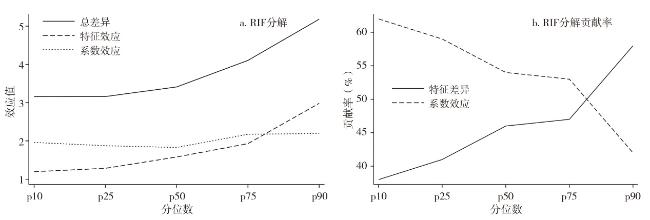
| 总差异 | 3.663*** | 3.159*** | 3.160*** | 3.411*** | 4.104*** | 5.181*** |
| 特征效应 | 1.711*** | 1.197*** | 1.285*** | 1.581*** | 1.930*** | 2.983*** |
| 贡献率(%) | 46.71 | 37.89 | 40.66 | 46.35 | 47.03 | 57.58 |
| 系数效应 | 1.952*** | 1.962*** | 1.875*** | 1.830*** | 2.174*** | 2.198*** |
| 贡献率(%) | 53.29 | 62.11 | 59.34 | 53.65 | 52.97 | 42.42 |
注:***、**、*分别表示1%、5%和10%的显著性水平。表6同。 |
表6 县域与非县域农民工市民化质量RIF分解具体情况Tab.6 The specific situation of RIF decomposition of the citizenization quality of migrant workers in county and non-county areas |
| 变量名 | 特征效应 | 系数效应 | |||||||||||
|---|---|---|---|---|---|---|---|---|---|---|---|---|---|
| 均值 | p10 | p25 | p50 | p75 | p90 | 均值 | p10 | p25 | p50 | p75 | p90 | ||
| 年龄 | 0.032*** | 0.011 | 0.026** | 0.035*** | 0.034* | 0.048 | 0.370 | -1.589** | -0.946 | 0.265 | 1.215 | 3.264** | |
| 性别 | -0.020*** | -0.016** | -0.014** | -0.014** | -0.025** | -0.049** | -0.065 | -0.152 | -0.103 | -0.081 | 0.186 | -0.345 | |
| 婚姻 | -0.042*** | -0.023* | -0.039*** | -0.041*** | -0.017 | -0.084** | 0.186 | 0.175 | 0.045 | 0.193 | 0.870 | -0.573 | |
| 健康状况 | 0.004 | 0.008 | 0.006 | 0.003 | 0.006 | -0.008 | 0.314 | 0.950 | 0.544 | 1.006 | -1.047 | 0.999 | |
| 教育年限 | 0.982*** | 0.436*** | 0.519*** | 0.749*** | 1.323*** | 2.299*** | 3.484*** | 2.853*** | 3.359*** | 4.227*** | 5.985*** | 0.562 | |
| 跨省 | 0.423*** | 0.330*** | 0.359*** | 0.443*** | 0.450*** | 0.542*** | 0.770*** | 0.344** | 0.490*** | 0.839*** | 0.843*** | 1.117** | |
| 省内跨市 | -0.019 | -0.039 | -0.040 | -0.031 | 0.013 | 0.002 | 0.083 | 0.085 | 0.093 | 0.136 | -0.084 | 0.185 | |
| 流动时间 | -0.060*** | -0.043*** | -0.045*** | -0.073*** | -0.074*** | -0.052* | 0.174 | 0.135 | 0.213 | 0.019 | 0.230 | 0.565 | |
| 家庭规模 | 0.014 | -0.011 | -0.035 | 0.008 | -0.020 | 0.099 | -0.912** | -0.664 | -1.367*** | -1.213*** | -1.053 | -0.481 | |
| 父母外出务工 | -0.005 | -0.002 | -0.002 | -0.003 | -0.009 | -0.012 | 0.056 | 0.046 | 0.017 | 0.058 | -0.057 | 0.169 | |
| 常数项 | - | - | - | - | - | - | -2.116 | -0.793 | -0.459 | -2.985** | -4.293* | -2.126 | |
① 北京、天津、上海3个直辖市没有县及县级市单位,故无县域市民化质量数据,各省份县域农民工市民化质量指数具体限于篇幅,留存备索。
| [1] |
|
| [2] |
杨晓军. 农民工对经济增长贡献与成果分享[J]. 中国人口科学, 2012(6):66-74,112.
|
| [3] |
|
| [4] |
|
| [5] |
刘传江, 程建林. 第二代农民工市民化:现状分析与进程测度[J]. 人口研究, 2008(5):48-57.
|
| [6] |
|
| [7] |
国务院发展研究中心课题组. 农民工市民化进程的总体态势与战略取向[J]. 改革, 2011(5):5-29.
|
| [8] |
|
| [9] |
陈映芳. “农民工”:制度安排与身份认同[J]. 社会学研究, 2005(3):119-132,244.
|
| [10] |
赵立新. 城市农民工市民化问题研究[J]. 人口学刊, 2006(4):40-45.
|
| [11] |
徐延辉, 龚紫钰. 社会质量与农民工的市民化[J]. 经济学家, 2019(7):90-100.
|
| [12] |
辛宝英. 农业转移人口市民化程度测评指标体系研究[J]. 经济社会体制比较, 2016(4):156-165.
|
| [13] |
王桂新, 沈建法, 刘建波. 中国城市农民工市民化研究——以上海为例[J]. 人口与发展, 2008(1):3-23.
|
| [14] |
魏后凯, 苏红键. 中国农业转移人口市民化进程研究[J]. 中国人口科学, 2013(5):21-29,126.
|
| [15] |
苏丽锋. 中国流动人口市民化水平测算及影响因素研究[J]. 中国人口科学, 2017(2):12-24,126.
|
| [16] |
张心洁, 周绿林, 曾益. 农业转移人口市民化水平的测量与评价[J]. 中国软科学, 2016(10):37-49.
|
| [17] |
王春超, 蔡文鑫. 流动人口市民化与推进路径测算研究——基于同质化水平测度的视角[J]. 经济社会体制比较, 2021(5):161-173.
|
| [18] |
佟大建, 金玉婷, 宋亮. 农民工市民化:测度、现状与提升路径——基本公共服务均等化视角[J]. 经济学家, 2022(4):118-128.
|
| [19] |
魏超, 吴洲, 李荣娟, 等. 湖北省县城城镇化质量测度及协调发展研究[J]. 经济地理, 2023, 43(6):95-105.
|
| [20] |
龙花楼, 徐雨利, 郑瑜晗, 等. 中国式现代化下的县域城乡融合发展[J]. 经济地理, 2023, 43(7):12-19.
|
| [21] |
方创琳, 赵文杰. 新型城镇化及城乡融合发展促进中国式现代化建设[J]. 经济地理, 2023, 43(1):10-16.
|
| [22] |
顾东东, 杜海峰, 王琦. 就地就近城镇化背景下农民工市民化的成本测算与发现——基于河南省三个县市的比较[J]. 管理评论, 2018, 30(3):240-247.
|
| [23] |
|
| [24] |
|
| [25] |
杨保军, 陈怡星, 吕晓蓓, 等. “一带一路”战略的空间响应[J]. 城市规划学刊, 2015(2):6-23.
|
| [26] |
|
| [27] |
刘素华. 建立我国就业质量量化评价体系的步骤与方法[J]. 人口与经济, 2005(6):36-40.
|
| [28] |
聂伟, 风笑天. 就业质量、社会交往与农民工入户意愿——基于珠三角和长三角的农民工调查[J]. 农业经济问题, 2016, 37(6):34-42,111.
|
| [29] |
郭新宇, 薛建良. 农民工住房选择及其影响因素分析[J]. 农业技术经济, 2011(12):87-93.
|
| [30] |
祝仲坤. 公共卫生服务如何影响农民工留城意愿——基于中国流动人口动态监测调查的分析[J]. 中国农村经济, 2021(10):125-144.
|
| [31] |
杨菊华. 中国流动人口的社会融入研究[J]. 中国社会科学, 2015(2):61-79,203-204.
|
| [32] |
祝仲坤, 冷晨昕. 住房状况、社会地位与农民工的城市身份认同——基于社会融合调查数据的实证分析[J]. 中国农村观察, 2018(1):96-110.
|
| [33] |
王晓丽. 从市民化角度修正中国城镇化水平[J]. 中国人口科学, 2013(5):87-95,128.
|
| [34] |
|
/
| 〈 |
|
〉 |