


国家战略驱动的跨界地区治理重构——以长三角生态绿色一体化发展示范区为例
|
唐蜜(1988—),女,博士,讲师,研究方向为城市与区域治理。E-mail:mitang@njupt.edu.cn |
收稿日期: 2024-08-10
修回日期: 2024-11-21
网络出版日期: 2025-07-07
基金资助
国家自然科学基金项目(42301270)
江苏省社会科学基金项目(23ZZB004)
Governance of Cross-Boundary Regions under National Strategies: Insights from the Ecological and Green Integration Development Demonstration Zone of the Yangtze River Delta, China
Received date: 2024-08-10
Revised date: 2024-11-21
Online published: 2025-07-07
唐蜜 , 罗小龙 , 张衔春 , 杨凌凡 . 国家战略驱动的跨界地区治理重构——以长三角生态绿色一体化发展示范区为例[J]. 经济地理, 2025 , 45(5) : 46 -56 . DOI: 10.15957/j.cnki.jjdl.2025.05.005
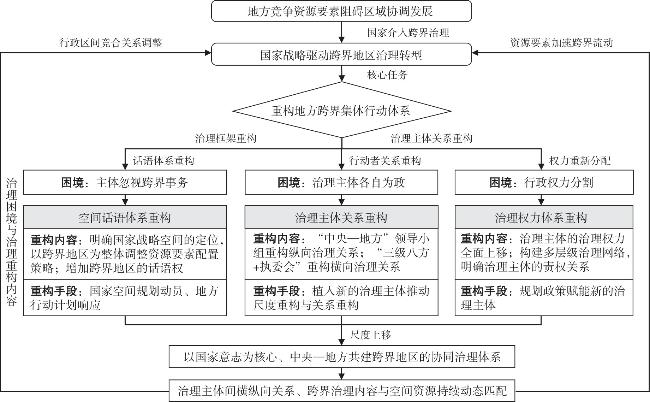
Based on the rescaling theory and the practice of the cross-boundary governance, this paper constructs a framework for the coordinated governance of cross-boundary regions (CBRs) in line with national strategies. Taking the Yangtze River Delta Ecological and Green Integration Development Demonstration Zone as a typical case, it further summarizes the logic and paths of central-local joint governance in CBRs. The study reveals that: First, the collaborative governance of CBRs adopts a flexible approach, with the central government providing guidance and supervision and local governments implementing, By reconstructing the discourse system, the state redefines governance principles and policy frameworks, there by reserving ample implementation flexibility for local governments. This, in turn, enables multi-level government cooperation to exhibit gradualness and stability, effectively breaking through development barriers caused by administrative divisions through coordinated resource allocation and strategic alignment. Second, in the process of cross-boundary regional governance, the central government attempts to reconcile local relations and optimize the distribution of local interests by reconstructing the spatial governance system, ultimately solving problems such as the lack of attention from local governments on cross-boundary governance affairs, fierce competition among regions, and fragmented governance power in cross-boundary regions. During this process, cross-boundary regions have not only become strategic arrangements for the central government to promote the adjustment of the powers and responsibilities of local governments, but also transformed into spatial expressions for the joint promotion of governance reconstruction by the national and local authorities. Third, the state builds a multi-level cross-boundary governance network through, specifically, adjusting the discourse system, restructuring governance leadership mechanisms, and optimizing power relations to enhance regional cooperation of CBRs. Focusing on the vertical reorganization of administrative subject power, the horizontal reconstruction of local competitive and cooperative relations, and the adjustment of responsibility and authority relations among regions, it specifically addresses the issue of fragmented development in CBRs. Under the mobilization of the central government and the active response of local governments, CBRs have achieved vertical hierarchical leapfrogging and horizontal cross-boundary integration in CBRs, thereby ensuring the reasonable distribution of interests among regions while realizing the intentions of the central government.
| [1] |
刘君德. 中国转型期“行政区经济”现象透视——兼论中国特色人文—经济地理学的发展[J]. 经济地理, 2006, 26(6):897-901.
|
| [2] |
周黎安, 陶婧. 官员晋升竞争与边界效应:以省区交界地带的经济发展为例[J]. 金融研究, 2011(3):15-26.
|
| [3] |
李国平, 吕爽. 京津冀跨域治理和协同发展的重大政策实践[J]. 经济地理, 2023, 43(1):26-33.
|
| [4] |
|
| [5] |
|
| [6] |
|
| [7] |
|
| [8] |
|
| [9] |
|
| [10] |
|
| [11] |
|
| [12] |
|
| [13] |
沈建法. 跨境城市区域中的城市管治——以香港为例[J]. 城市规划, 2002(9):45-50.
|
| [14] |
杨柳青, 陈雯, 张鹏, 等. 长三角一体化背景下城际断头路联通障碍及治理路径研究[J]. 地理科学, 2023(10):1720-1728.
|
| [15] |
张衔春, 唐承辉, 岳文泽. 地域重构视角下区域空间生产与治理——以深汕特别合作区为例[J]. 地理科学, 2022, 42(3):373-380.
|
| [16] |
杨凌凡, 罗小龙, 唐蜜, 等. 长三角合作共建园区转型路径与机制——基于“同质多形”视角[J]. 地理科学, 2024, 44(3):379-390.
|
| [17] |
锁利铭, 李雪. 从“单一边界”到“多重边界”的区域公共事务治理——基于对长三角大气污染防治合作的观察[J]. 中国行政管理, 2021(2):92-100.
|
| [18] |
宋涛, 孙曼, 刘志高. 改革开放以来中国西南边境地区制度与产业协同演化研究——以云南勐腊为例[J]. 地理研究, 2022, 41(3):633-646.
|
| [19] |
李晓玲, 谭爽, 魏冶, 等. 历史演化视角下跨境经济区域合作研究——以图们江次区域国际合作为例[J]. 世界地理研究, 2024, 33(4):1-12.
|
| [20] |
|
| [21] |
叶超, 赵江南, 张清源, 等. 跨界治理的理论重构——以长江三角洲地区为例[J]. 地理科学, 2022, 42(3):363-372.
|
| [22] |
陶希东. 跨省区域治理:中国跨省都市圈经济整合的新思路[J]. 地理科学, 2005(5):19-26.
|
| [23] |
陈宏胜, 李志刚, 肖扬, 等. 基于区域功能视角的边界新区发展研究——对深圳前海合作区与珠海横琴合作区的比较[J]. 城市规划, 2022, 46(4):21-29.
|
| [24] |
|
| [25] |
匡贞胜, 孙斌栋. 新国家空间框架解读中国空间转型现象的再审视[J]. 地理科学进展, 2021, 40(3):511-523.
|
| [26] |
晁恒, 马学广, 李贵才. 尺度重构视角下国家战略区域的空间生产策略——基于国家级新区的探讨[J]. 经济地理, 2015, 35(5):1-8.
|
| [27] |
周黎安. 转型中的地方政府:官员激励与治理(第二版)[M]. 上海: 格致出版社,上海三联书店,上海人民出版社, 2017.
|
| [28] |
匡贞胜, 赵彪, 孙斌栋. 结构变迁视角下的粤港澳跨域协作治理[J]. 地理科学, 2023, 43(7):1174-1184.
|
| [29] |
殷洁, 罗小龙. 尺度重组与地域重构:城市与区域重构的政治经济学分析[J]. 人文地理, 2013, 28(2):67-73.
|
| [30] |
|
| [31] |
苗长虹. 变革中的西方经济地理学:制度、文化、关系与尺度转向[J]. 人文地理, 2004(4):68-76.
|
| [32] |
|
| [33] |
|
| [34] |
|
| [35] |
|
| [36] |
王丰龙, 刘云刚. 尺度政治理论框架[J]. 地理科学进展, 2017, 36(12):1500-1509.
|
| [37] |
|
| [38] |
谷浩, 李明, 李金龙. 资本积累驱动下的多尺度形态及其特征——基于空间与地域的尺度分析[J]. 经济地理, 2021, 41(5):29-36.
|
| [39] |
马学广, 李鲁奇. 尺度重组中海洋国家战略区域的策略与制度建构——以山东半岛蓝色经济区为例[J]. 经济地理, 2016, 36(12):8-14.
|
| [40] |
|
| [41] |
|
| [42] |
罗小龙, 杨凌凡, 唐蜜. 新发展格局下城际合作共建园区的发展与制度创新[J]. 城市学刊, 2024, 45(3):1-7.
|
| [43] |
唐蜜, 罗小龙, 王绍博. 大都市区跨界地区空间演化及动力机制研究[J]. 人文地理, 2022, 37(2):103-111.
|
| [44] |
陈雯, 刘伟, 孙伟. 太湖与长三角区域一体化发展:地位、挑战与对策[J]. 湖泊科学, 2021, 33(2):327-335.
|
| [45] |
郑德高, 刘迪, 赵宪峰, 等. 跨界地区一体化规划编制创新——以长三角生态绿色一体化发展示范区为例[J]. 城市规划学刊, 2022(Sup2):3-8.
|
| [46] |
张京祥. 国家—区域治理的尺度重构:基于“国家战略区域规划”视角的剖析[J]. 城市发展研究, 2013, 20(5):45-50.
|
| [47] |
周雪光, 刘世定, 折晓叶. 国家建设与政府行为[M]. 北京: 中国社会科学出版社, 2012.
|
| [48] |
张衔春, 栾晓帆, 马学广, 等. 深汕特别合作区协同共治型区域治理模式研究[J]. 地理科学, 2018, 38(9):1466-1474.
|
/
| 〈 |
|
〉 |