


Impact of Destination Placement in Video Games on Players' Travel Intention
Received date: 2025-08-09
Revised date: 2026-01-07
Online published: 2026-04-10
Based on the "stimulus-organism-response" (SOR) theory and concepts such as presence, flow experience, and arousal, this empirical study employs structural equation model, taking the domestic AAA game Black Myth: Wukong as an example, to conduct empirical research on the travel intentions of video game players in the context of tourism destination scene implantation. The research finds that: 1) The implantation of tourism destination scenes in video games can evoke a multi-dimensional sense of presence in players. The conversion of travel intention does not follow a single linear path, but it can occur through the complex pathway of "presence, psychological state, behavioral intention". 2) Both physical presence and social presence exhibit driving effects on arousal and flow experience. The chain mediating roles of arousal and flow experience between presence and travel intentions are confirmed, though the mediating effect of flow experience is stronger than that of arousal. Arousal alone shows limited mediating efficacy, while flow experience, as a critical antecedent of travel intention, highlights the uniqueness of tourism decision-making compared to general commodity consumption. 3) Social presence demonstrates a greater influence than physical presence on converting players' travel intentions into actual behaviors, with the transformation of travel intentions among gaming communities relying on deep psychological immersion and emotional connections.
JIA Yaoyan , LIU Dajun , YIN Jiaojiao , QI Ziyi . Impact of Destination Placement in Video Games on Players' Travel Intention[J]. Economic geography, 2026 , 46(2) : 235 -243 . DOI: 10.15957/j.cnki.jjdl.2026.02.023
表1 样本描述统计表Tab.1 Statistical table of sample description |
| 变量 | 类别 | 频率 | 百分比(%) | 变量 | 类别 | 频率 | 百分比(%) |
|---|---|---|---|---|---|---|---|
| 性别 | 男 | 357 | 67.9 | 玩家游戏年限 | <1年 | 28 | 5.3 |
| 女 | 169 | 32.1 | 1~3年 | 91 | 17.3 | ||
| 年龄 | 16~18岁 | 34 | 6.5 | 3~5年 | 142 | 27.0 | |
| 19~30岁 | 459 | 87.3 | 5~10年 | 155 | 29.5 | ||
| 31~50岁 | 32 | 6.1 | >10年 | 110 | 20.9 | ||
| >51岁 | 1 | 0.2 | 《黑神话:悟空》游戏进度 | 1~2章 | 113 | 21.5 | |
| 受教育程度 | 高中及以下 | 26 | 4.9 | 3~5章 | 82 | 15.6 | |
| 本科/本科在读 | 421 | 80.0 | 1周目 | 122 | 23.2 | ||
| 硕士研究生/在读 | 70 | 13.3 | 2周目 | 87 | 16.5 | ||
| 博士研究生/在读 | 9 | 1.7 | >2周目 | 122 | 23.2 |
注:《黑神话:悟空》国际分级为16+,因此年龄统计自16岁始,未满16岁玩家不参与问卷填写。 |
表2 信度和收敛效度检验Tab.2 Reliability and convergent validity tests |
| 测量变量 | 题项 | 标准化因子载荷 | Cronbach's α | CR | AVE |
|---|---|---|---|---|---|
| 空间临场感 | PR1游戏过程中仿佛置身西游世界 | 0.762 | 0.876 | 0.876 | 0.640 |
| PR2游戏过程中能够意识到某些场景来自真实世界 | 0.788 | ||||
| PR3游戏中现实场景的真实再现会激发我的探索兴趣 | 0.784 | ||||
| PR4游戏结束后我仿佛旅行之后回到真实世界 | 0.809 | ||||
| 社会临场感 | SP1与游戏角色产生联系,我就是那个天命人 | 0.807 | 0.903 | 0.894 | 0.677 |
| SP2游戏情节场景让我产生了与他人分享冲动 | 0.887 | ||||
| SP3游戏能够满足我的社交需求,如通过论坛、直播、测评等与他人建立联系 | 0.843 | ||||
| SP4我会因为其他玩家的评价或分享加深对取景地的兴趣 | 0.847 | ||||
| 唤起 | Ar1这款游戏让我不再困倦、无聊,变得清醒 | 0.762 | 0.865 | 0.866 | 0.618 |
| Ar2这款游戏让我感到兴奋 | 0.873 | ||||
| Ar3这款游戏让我感到刺激 | 0.823 | ||||
| Ar4游戏情节让我产生共鸣或情绪波动 | 0.734 | ||||
| 心流体验 | FE1游戏过程中,感觉时间过得很快 | 0.809 | 0.887 | 0.910 | 0.717 |
| FE2游戏中,让我暂时忘了周围的事情 | 0.857 | ||||
| FE3感到被完全地吸引,投入其中 | 0.816 | ||||
| FE4游戏过程中心情愉悦,享受其中 | 0.809 | ||||
| 旅游意愿 | TI1我产生了去取景地旅游的冲动 | 0.799 | 0.859 | 0.860 | 0.606 |
| TI2我想进一步了解现实中的旅游景区 | 0.793 | ||||
| TI3我会推荐亲友去游戏取景地游玩 | 0.726 | ||||
| TI4未来一年我会计划去取景地游玩 | 0.795 |
表3 判别效度检验Tab.3 Discriminant validity test |
| 社会临场感 | 空间临场感 | 唤起 | 心流体验 | 旅游意愿 | |
|---|---|---|---|---|---|
| 社会临场感 | 0.823 | ||||
| 空间临场感 | 0.448 | 0.800 | |||
| 唤起 | 0.482 | 0.445 | 0.786 | ||
| 心流体验 | 0.598 | 0.456 | 0.519 | 0.847 | |
| 旅游意愿 | 0.508 | 0.341 | 0.352 | 0.529 | 0.779 |
注:对角线上的数字为变量的AVE平方根,对角线下的数字为变量间的相关系数。 |
表4 结构模型拟合度检验Tab.4 Fit test of structural equation model |
| 指标类型 | χ²/df | RMSEA | AGFI | IFI | TLI | CFI | GFI |
|---|---|---|---|---|---|---|---|
| 适配标准 | <5 | <0.08 | >0.9 | >0.9 | >0.9 | >0.9 | >0.9 |
| 拟合结果 | 1.267 | 0.023 | 0.953 | 0.993 | 0.992 | 0.993 | 0.964 |
表5 模型拟合路径系数Tab.5 Path coefficients of model fitting |
| 路径 | 标准化系数 | 标准误差 | C.R.值 | 显著性 | 鉴定结果 |
|---|---|---|---|---|---|
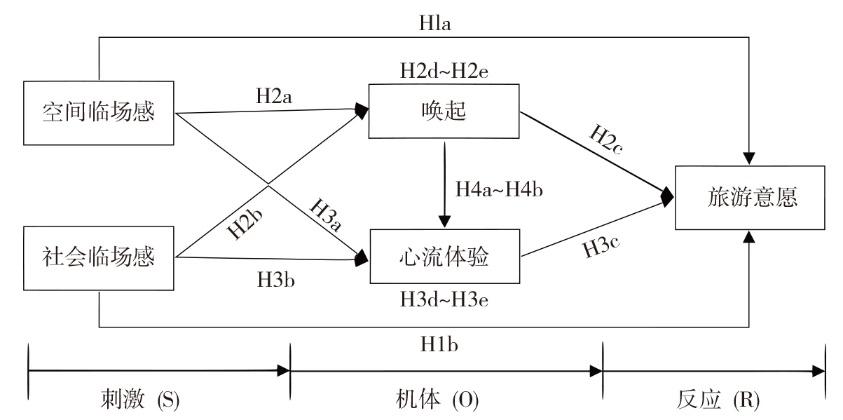
| H1a:空间临场感→旅游意愿 | 0.058 | 0.051 | 1.115 | 0.265 | 不成立 |
| H1b:社会临场感→旅游意愿 | 0.276 | 0.058 | 4.604 | *** | 成立 |
| H2a:空间临场感→唤起 | 0.287 | 0.055 | 5.544 | *** | 成立 |
| H2b:社会临场感→唤起 | 0.354 | 0.055 | 6.805 | *** | 成立 |
| H2c:唤起→旅游意愿 | 0.024 | 0.051 | 0.434 | 0.661 | 不成立 |
| H3a:空间临场感→心流体验 | 0.163 | 0.053 | 3.463 | ** | 成立 |
| H3b:社会临场感→心流体验 | 0.404 | 0.057 | 7.990 | *** | 成立 |
| H3c:心流体验→旅游意愿 | 0.352 | 0.053 | 5.309 | *** | 成立 |
注:*、**、***分别表示在5%、1%、0.1%水平上显著。表6同。 |
表6 中介效应检验结果Tab.6 Mediation effect test results |
| 路径 | 效应值 | SE | 95%CI下限 | 95%CI上限 | 显著性 | 鉴定结果 |
|---|---|---|---|---|---|---|
| H2d:空间临场感→唤起→旅游意愿 | 0.007 | 0.019 | -0.026 | 0.049 | 0.636 | 不成立 |
| H2e:社会临场感→唤起→旅游意愿 | 0.008 | 0.023 | -0.031 | 0.059 | 0.657 | 不成立 |
| H3d:空间临场感→心流体验→旅游意愿 | 0.052 | 0.020 | 0.020 | 0.101 | ** | 成立 |
| H3e:社会临场感→心流体验→旅游意愿 | 0.127 | 0.034 | 0.068 | 0.205 | *** | 成立 |
| H4a:空间临场感→唤起→心流体验→旅游意愿 | 0.023 | 0.009 | 0.010 | 0.049 | *** | 成立 |
| H4b:社会临场感→唤起→心流体验→旅游意愿 | 0.028 | 0.010 | 0.014 | 0.054 | *** | 成立 |
| [1] |
戴焱淼. 电竞简史:从游戏到体育[M]. 上海: 上海人民出版社, 2019.
|
| [2] |
何威, 唐贾军. 中国游戏产业发展报告(2024)[M]. 北京: 社会科学文献出版社, 2024.
|
| [3] |
胡钰, 朱戈奇. 网络游戏与中华优秀传统文化的当代传播[J]. 南京社会科学, 2022(7):155-162.
|
| [4] |
宁昌会, 奚楠楠. 国外游戏化营销研究综述与展望[J]. 外国经济与管理, 2017, 39 (10):72-85.
|
| [5] |
何威, 刘梦霏. 游戏研究读本[M]. 上海: 华东师范大学出版社, 2020.
|
| [6] |
|
| [7] |
张洁梅, 张姊威. 视觉营销如何唤起旅游电商直播观众的购买意愿?[J]. 经济与管理评论, 2023, 39 (5):138-149.
|
| [8] |
吴华君, 葛文双, 何聚厚. 教师支持对MOOC课程持续学习意愿的影响研究——基于S-O-R和TAM的视角[J]. 现代远距离教育, 2020,(3):89-96.
|
| [9] |
|
| [10] |
|
| [11] |
|
| [12] |
|
| [13] |
郑春晖, 张佳, 温淑盈. 虚与实:虚拟旅游中的人地情感依恋与实地旅游意愿[J]. 旅游学刊, 2022, 37 (4):104-115.
|
| [14] |
姚延波, 贾广美. 社交媒体旅游分享对潜在旅游者冲动性旅游意愿的影响研究:基于临场感视角[J]. 南开管理评论, 2021, 24 (3):72-82.
|
| [15] |
|
| [16] |
时朋飞, 熊元斌, 吕丹. 调节点特质、 旅游地感知价值与冲动性旅游[J]. 商业研究, 2018(1):169-176.
|
| [17] |
薛强. 赛博空间里的虚拟生存[M]. 上海: 复旦大学出版社, 2018.
|
| [18] |
|
| [19] |
何琼峰. 国内居民出游意愿的影响因素及区域格局[J]. 经济地理, 2011, 31(10):1754-1760.
|
| [20] |
王华, 李兰. 生态旅游涉入、群体规范对旅游者环境友好行为意愿的影响——以观鸟旅游者为例[J]. 旅游科学, 2018, 32(1):86-95.
|
| [21] |
阴姣姣, 谢双玉, 韩磊, 等. 旅游危机响应感知对城市形象及出游意愿的影响[J]. 华中师范大学学报(自然科学版), 2023, 57(6):913-926.
|
| [22] |
|
| [23] |
汪振汉. 电影休闲美学的流变——从电影到电影衍生品[J]. 当代电影, 2019(6):144-147.
|
| [24] |
|
| [25] |
沈涵, 滕凯. 旅游目的地广告的受众临场感和目的地态度研究[J]. 旅游学刊, 2015, 30(12):66-73.
|
| [26] |
周肖帆, 张梦, 刘娜, 等. 缘何成“真”?圣地巡礼游客的真实性体验研究[J]. 旅游学刊, 2024, 39(3):133-146.
|
| [27] |
|
| [28] |
|
| [29] |
|
| [30] |
|
| [31] |
|
| [32] |
|
| [33] |
|
| [34] |
|
| [35] |
|
/
| 〈 |
|
〉 |