


The Spatiotemporal Distribution Characteristics of Sports Service Facilities in the Urban Agglomeration in the Middle Reaches of the Yangtze River and Its Influencing Factors
Received date: 2025-05-16
Revised date: 2025-09-28
Online published: 2025-12-23
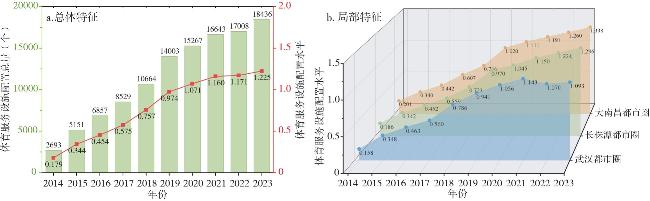
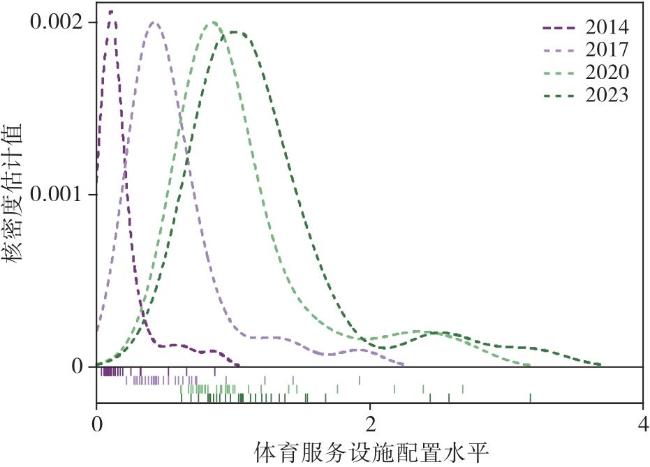
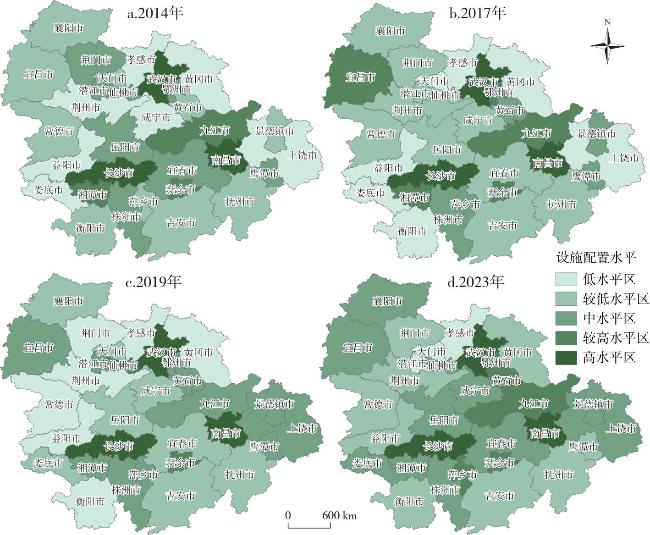
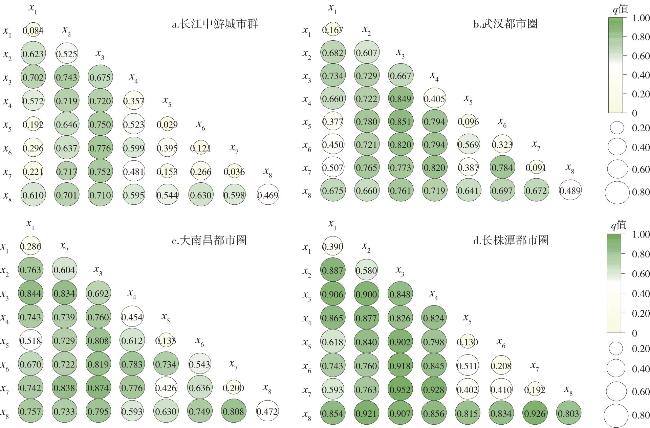
The optimal allocation of sports service facilities is an important support for implementing the "Healthy China" strategy and the equalization of public services. Based on the POI data of 31 prefecture-level cities in the Central Yangtze River Urban Agglomeration from 2014 to 2023, this study comprehensively employs kernel density estimation, spatial autocorrelation and optimal geographic detector methods to reveal the spatio-temporal differentiation characteristics and influencing factors of the configuration level of sports service facilities. The results show that: 1) The configuration level of sports service facilities in the urban agglomeration in the middle reaches of the Yangtze River has increased from 0.179 to 1.225, and the total number of facilities has jumped from 2693 to 18436, showing a continuous growth trend and forming a gradient pattern of "Greater Nanchang Metropolitan Area > Changsha-Zhuzhou-Xiangtan Metropolitan Area > Wuhan Metropolitan Area". The nuclear density curve shifts to the right and the height of the main peak decreases, reflecting that the spatial distribution is gradually becoming more balanced. However, there is still trailing lag in peripheral cities such as Ji 'an and Tianmen. 2) The types of sports service facilities show a "pyramid-shaped" differentiation, with fitness centers and billiard halls having the highest density. The spatial distribution presents a "core-edge" pattern. The global Moran's I value ranges from -0.043 to -0.132, showing a significant spatial negative correlation. 3) Social and economic development factors have the strongest impact on the configuration level of sports service facilities, while traffic carrying capacity and environmental quality factors have relatively weak influences on it. Moreover, the level of urbanization and the accessibility of the road network have the strongest explanatory power. In the future, the configuration level of sports service facilities should be enhanced in a coordinated manner from multiple dimensions, including promoting social and economic development, optimizing urban spatial layout and transportation networks.
QI Libin , LIU Yingli , SU Ling . The Spatiotemporal Distribution Characteristics of Sports Service Facilities in the Urban Agglomeration in the Middle Reaches of the Yangtze River and Its Influencing Factors[J]. Economic geography, 2025 , 45(11) : 80 -88 . DOI: 10.15957/j.cnki.jjdl.2025.11.008
表1 长江中游城市群体育服务设施分布结构特征Tab.1 Distribution structure characteristics of sports service facilities |
| 类型 | 长江中游城市群 | 武汉都市圈 | 大南昌都市圈 | 长株潭都市圈 | |||||||
|---|---|---|---|---|---|---|---|---|---|---|---|
| 数量 (个) | 百分比 (%) | 数量 (个) | 百分比 (%) | 数量 (个) | 百分比 (%) | 数量 (个) | 百分比 (%) | ||||
| 保龄球馆 | 98 | 0.085 | 29 | 0.063 | 26 | 0.084 | 43 | 0.111 | |||
| 壁球场 | 21 | 0.018 | 19 | 0.041 | 0 | 0.000 | 2 | 0.005 | |||
| 高尔夫球场 | 334 | 0.289 | 144 | 0.314 | 50 | 0.162 | 140 | 0.362 | |||
| 户外健身场所 | 268 | 0.232 | 133 | 0.290 | 36 | 0.116 | 99 | 0.256 | |||
| 滑雪场 | 158 | 0.137 | 83 | 0.181 | 23 | 0.074 | 52 | 0.134 | |||
| 健身中心 | 42566 | 36.846 | 18338 | 39.934 | 9997 | 32.309 | 14231 | 36.809 | |||
| 篮球场馆 | 7330 | 6.345 | 3051 | 6.644 | 1911 | 6.176 | 2368 | 6.125 | |||
| 溜冰场 | 1478 | 1.279 | 481 | 1.047 | 487 | 1.574 | 510 | 1.319 | |||
| 马术俱乐部 | 167 | 0.145 | 78 | 0.170 | 33 | 0.107 | 56 | 0.145 | |||
| 乒乓球馆 | 2665 | 2.307 | 1293 | 2.816 | 462 | 1.493 | 910 | 2.354 | |||
| 赛马场 | 99 | 0.086 | 44 | 0.096 | 26 | 0.084 | 29 | 0.075 | |||
| 水上活动中心 | 1910 | 1.653 | 666 | 1.450 | 595 | 1.923 | 649 | 1.679 | |||
| 台球厅 | 24635 | 21.324 | 7362 | 16.032 | 8615 | 27.842 | 8658 | 22.394 | |||
| 跆拳道场馆 | 11307 | 9.787 | 4272 | 9.303 | 3500 | 11.311 | 3535 | 9.143 | |||
| 网球场 | 1745 | 1.510 | 1031 | 2.245 | 410 | 1.325 | 304 | 0.786 | |||
| 游泳馆 | 8133 | 7.040 | 3210 | 6.990 | 1839 | 5.943 | 3084 | 7.977 | |||
| 羽毛球场 | 3989 | 3.453 | 1753 | 3.817 | 895 | 2.893 | 1341 | 3.469 | |||
| 综合体育馆 | 7170 | 6.206 | 3158 | 6.877 | 1718 | 5.552 | 2294 | 5.933 | |||
| 足球场 | 1452 | 1.257 | 776 | 1.690 | 319 | 1.031 | 357 | 0.923 | |||
| 总量 | 115525 | 100.000 | 45921 | 100.000 | 30942 | 100.000 | 38662 | 100.000 | |||
表2 2014—2023年全局Moran's I值结果Tab.2 Global Moran's I value results(2014—2023) |
| 年份 | 2014 | 2015 | 2016 | 2017 | 2018 | 2019 | 2020 | 2021 | 2022 | 2023 |
|---|---|---|---|---|---|---|---|---|---|---|
| Moran's I | -0.098* | -0.098* | -0.101* | -0.085 | -0.105* | -0.114* | -0.132** | -0.131** | -0.100 | -0.043 |
注:*表示P<0.1,**表示P<0.05。 |
表3 区域体育服务设施配置水平的影响因素Tab.3 Influencing factors of the configuration level of sports service facilities |
| 维度 | 影响因子 | 具体指标(单位) | 计算方法 |
|---|---|---|---|
| 社会经济发展 | 人口规模(x1) | 人口密度(万人/km2) | 常住人口/行政区面积 |
| 居民经济条件(x2) | 人均GDP(元/人) | 统计年鉴获取 | |
| 城镇化水平(x3) | 城镇化率(%) | 统计年鉴获取 | |
| 生态环境质量 | 生态宜居水平(x4) | 每万人公园绿地面积(hm2/万人) | 统计年鉴获取 |
| 环境质量(x5) | 空气优良天数(天) | 全国空气质量监测站数据 | |
| 基础设施建设 | 路网通达性(x6) | 等级公路密度(km/km2) | 公路里程/行政区面积 |
| 交通承载力(x7) | 人均公路面积(km2) | 城市道路面积/常住人口 | |
| 建设空间(x8) | 每万人建成区面积(km2/万人) | 建成区面积/人口总量 |
| [1] |
崔喆, 何莲娜, 吴兰若, 等. 体育设施多维度时空供需匹配与优化——以北京市石景山区为例[J]. 规划师, 2024, 40(5):58-67.
|
| [2] |
马弘宇, 李燕领, 张润晨, 等. 全民健身公共服务资源配置效率测度及时空演进研究[J]. 天津体育学院学报, 2025, 40(1):45-54.
|
| [3] |
姚娜, 魏伟, 洪梦谣. 区域共享型大健康设施时空格局演变及机制解析——以武汉都市圈为例[J]. 地域研究与开发, 2023, 42(6):46-52,59.
|
| [4] |
|
| [5] |
陈昆仑, 韩泽雨, 张瑜, 等. 中国高水平网球运动员的时空分布特征及影响因素[J]. 热带地理, 2025, 45(2):264-274.
|
| [6] |
王金伟, 邹明乐, 徐晓文, 等. 东北三省滑雪场时空格局演变及其影响因素[J]. 经济地理, 2023, 43(8):187-199.
|
| [7] |
史兵, 刘建峰, 张西平, 等. 西安市羽毛球馆空间分布研究[J]. 中国体育科技, 2010, 46(2):45-50,60.
|
| [8] |
张建波, 李诚固, 刘伟, 等. 长春市健身空间的演变特征、类型与影响因素[J]. 地域研究与开发, 2019, 38(1):71-75,80.
|
| [9] |
李强谊, 钟亚平. 中国体育资源配置水平的空间差异分析[J]. 统计与决策, 2020, 36(13):81-85.
|
| [10] |
|
| [11] |
|
| [12] |
胡娟, 杨靖三, 陈刚, 等. 江苏县域公共体育服务资源的配置水平与影响机制分析[J]. 体育科学, 2016, 36(10):18-25.
|
| [13] |
江磊, 张佑印, 杨丽红, 等. 中国青少年公共体育资源配置时空演化与溢出效应研究——基于省际面板数据的空间杜宾模型分析[J]. 世界地理研究, 2024, 33(6):167-182.
|
| [14] |
李娜, 寇朝阳. 长江经济带滑雪场空间分布特征及其影响因素分析[J]. 山东体育学院学报, 2025, 41(5):96-106.
|
| [15] |
林岚, 张雪, 刘群, 等. 大型体育场馆对城市居民休闲体育行为时空规律的影响研究——以国内三个城市为例[J]. 人文地理, 2022, 37(1):116-125.
|
| [16] |
|
| [17] |
|
| [18] |
何丰, 沈磊, 白宇飞. 数字经济对城市公共体育服务高质量发展的影响和门槛效应[J]. 北京体育大学学报, 2024, 47(1):63-78.
|
| [19] |
周亦璟, 袁红, 钟沐成, 等. 全民健身视角下老城区公共体育服务空间布局及优化策略:以成都市金牛区为例[J]. 华中农业大学学报, 2024, 43(3):220-229.
|
| [20] |
寇朝阳, 李娜. 基于ArcGIS的参与型体育旅游资源空间分布及影响因素——以长江中游城市群为例[J]. 吉林体育学院学报, 2024, 40(5):44-51.
|
| [21] |
湛东升, 张文忠, 谌丽, 等. 城市公共服务设施配置研究进展及趋向[J]. 地理科学进展, 2019, 38(4):506-519.
|
| [22] |
宋劲松, 袁梦伊, 张丽娜. 新型城镇化影响区域高质量发展的空间效应——以长江中游城市群为例[J]. 经济地理, 2024, 44(11):43-51.
|
| [23] |
薛亮, 王晶晶, 冯晓露. 加快建设体育强国:提升国民体育参与度的国际经验与中国路径[J]. 中国体育科技, 2024, 60(10):55-63.
|
| [24] |
席玉宝, 鲁雷. 长江经济带体育产业现状与发展对策研究[J]. 体育学研究, 2024, 38(5):66-78.
|
| [25] |
潘辰鸥, 樊炳有. 极化中平衡:区域基本公共体育服务均等化的理论框架与推进策略[J]. 体育学刊, 2025, 32(2):67-76.
|
| [26] |
史景龙, 卫才胜. 我国城市体育空间异化的表征、成因及消解[J]. 体育文化导刊, 2022(9):8-13.
|
| [27] |
|
| [28] |
于雪霞, 周国华, 吴国华, 等. 中国中部农区城乡融合发展的时空特征及驱动机制[J]. 地理研究, 2025, 44(2):400-418.
|
| [29] |
|
| [30] |
王红梅, 肖艳. 区域公共体育设施均等化测度与优化——以湖南省为例[J]. 经济地理, 2023, 43(8):137-143.
|
/
| 〈 |
|
〉 |