


Spatial Differentiation and Formation Mechanism of CBEQ from the Perspective of Resident Perception in Lanzhou, China
Received date: 2024-09-30
Revised date: 2025-03-01
Online published: 2025-11-20
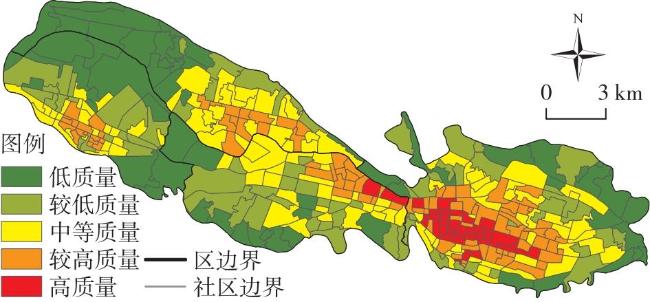
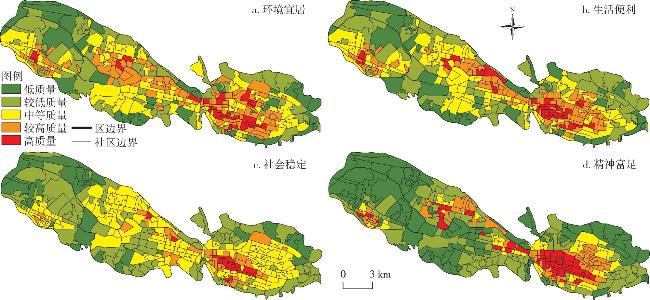
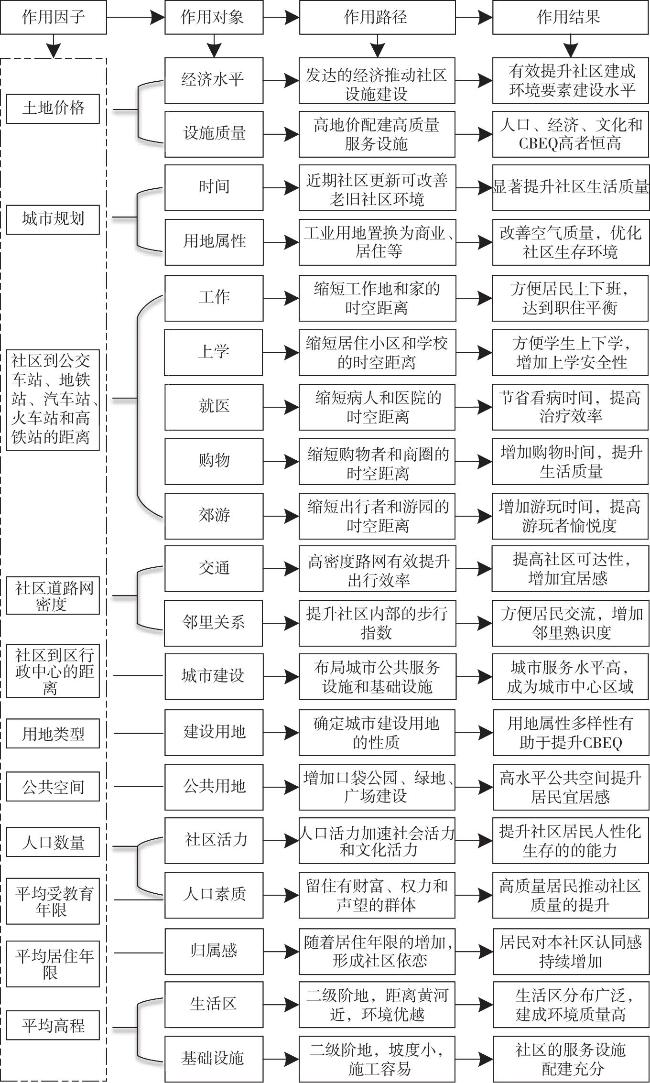
The improvement of people's quality of life and the solid promotion of common wealth in the new era are greatly supported by the important foundation of the high community built environment quality(CBEQ). In this paper, Lanzhou, the center city of Northwest China, is taken as an example, and the subjective evaluation index system of CBEQ under the perspective of common wealth is constructed based on the questionnaire data. The results show that: The distribution of CBEQ is significantly influenced by the Yellow River, displaying an east-west axial belt-like core-edge spatial characteristic. High-quality communities tend to be in close proximity to surrounding high-quality and higher-quality communities, forming a spatial aggregation phenomenon of high-quality communities. From a sub-dimensional perspective, the overall spatial distribution of environmental livability is balanced, but there is the phenomenon of inverse centralization. The convenience of life presents the spatial agglomeration characteristics of single-center and axial belt. Social stability forms the spatial distribution characteristics of single-center and dotted with the district government as the core. Spiritual affluence presents the spatial structure characteristics of multi-center of different levels. The primary factors, such as land price, urban planning, distance to the district administrative center, average years of education, and public space, have always played a fundamental role, while the secondary factors, such as distance to the station, population, distance to the subway station, density of the community's road network, type of land use, average years of residency, and average elevation, play a key role, and their interaction contributes to the formation of the spatial differentiation pattern of CBEQ. The interactions between them contributed to the formation of the spatial differentiation pattern of CBEQ. Among them, the force of land price, distance from the community to the subway station, distance from the community to the station, and public space continued to increase.
CHEN Long , ZHANG Zhibin , WANG Xiaoqi , ZHAO Xuewei , DONG Jianhong . Spatial Differentiation and Formation Mechanism of CBEQ from the Perspective of Resident Perception in Lanzhou, China[J]. Economic geography, 2025 , 45(10) : 90 -99 . DOI: 10.15957/j.cnki.jjdl.2025.10.010
表1 社区建成环境质量水平评价指标体系及说明Tab.1 The CBEQ evaluation index system |
| 准则层 | 要素层 | 指标层 | 权重 |
|---|---|---|---|
| 环 境 宜 居 | 居住条件 | 停车便利性评价 | 0.046 |
| 楼层内部交通满意度 | 0.042 | ||
| 房屋空间结构满意度 | 0.025 | ||
| 居住环境 | 夜晚照明 | 0.036 | |
| 对社区卫生环境评价(环境卫生、垃圾处理、污水排水) | 0.049 | ||
| 社区座椅数量 | 0.035 | ||
| 人行道质量满意度 | 0.038 | ||
| 社区绿化评价 | 0.035 | ||
| 生 活 便 利 | 交通便利 | 上下班通勤便利度评价 | 0.061 |
| 教育便利 | 上学便利程度以及对教育质量评价 | 0.056 | |
| 生活服务 | 小区到商店/公园/超市/理发店等的便利程度及其服务质量评价 | 0.052 | |
| 小区到药店/医院的便利程度 | 0.045 | ||
| 小区到运动场所的便利程度 | 0.038 | ||
| 社 会 稳 定 | 社区安全 | 儿童娱乐安全评价 | 0.053 |
| 对社区管理工作评价 | 0.042 | ||
| 对社区治安评价 | 0.045 | ||
| 近一年社区发生的偷盗事件 | 0.021 | ||
| 近一年社区发生的打架斗殴事件 | 0.017 | ||
| 应急避难 | 距离紧急避难场所的可达性 | 0.044 | |
| 精 神 富 足 | 社交空间 | 邻里熟识度 | 0.042 |
| 邻里交往度 | 0.048 | ||
| 文化休闲 | 文艺活动(公园团体唱歌等) | 0.024 | |
| 小坐交谈;棋牌活动;周边游 | 0.026 | ||
| 社区幸福感 | 居住幸福感 | 0.043 | |
| 出行幸福感 | 0.037 |
表2 地理探测器的变量和指标说明Tab.2 Variables and indicators of the geographical detectors |
| 影响因子 | 数据获得途径 | 单位 | 定义与解释 | 分级 |
|---|---|---|---|---|
| X1社区到区中心距离 | ArcGIS距离工具 | m | 到最近区行政中心的距离(取对数) | 9 |
| X2社区到地铁站距离 | ArcGIS距离工具 | m | 到最近地铁站的距离(取对数) | 8 |
| X3社区到车站距离 | ArcGIS距离工具 | m | 到最近公交车站、汽车站、火车站和高铁站的距离(取对数) | 9 |
| X4社区道路网密度 | Openstreetmap | m/m2 | 路网密度(取对数) | 8 |
| X5社区到黄河的距离 | ArcGIS距离工具 | m | 到最近黄河的距离(取对数) | 6 |
| X6平均高程 | ArcGIS栅格统计 | m | 平均高程值(取对数) | 7 |
| X7人口数量 | 第七次人口普查数据 | 万人 | 社区人口数量:(Pi /PSj)1·街道人口(取对数) | 6 |
| X8土地价格 | 2020年兰州市商业基准地价 | 元/m2 | 设定基准地价分七级,其中一级代表最高地价并赋值为7 | 7 |
| X9二手房均价 | 安居客二手房官网2 | 元/m2 | 二手房均价(取对数) | 6 |
| X10城市规划 | 兰州市城市总体规划第一版到第五版用地属性变更时间 | 年份 | 依据用地属性变更次数,依次赋值为1、2、3、4 | 4 |
| X11用地类型 | 第五版兰州市国土空间规划现状图 | 类 | 用地面积≥1/2的类型确定为该社区用地属性,否则为混合用地 | 6 |
| X12就业岗位 | 第七次人口普查数据 | 个 | 用就业人口数量表示就业岗位:(Pi /PSj)1·街道就业人口(取对数) | 6 |
| X13平均受教育年限 | 第七次人口普查数据 | 年 | 首先计算社区受教育人口:(Pi /PSj)1·街道不同阶段人口,再根据公式计算人均受教育年限3(取对数) | 6 |
| X14公共空间 | 第五版兰州市国土空间规划现状图 | m2 | 社区内公园与绿地等面积占社区面积的比例 | 6 |
| X15平均居住年限 | 调研问卷 | 年 | 被调研者所在社区的平均居住年限 | 6 |
注:1.Pi为第i个社区的人口数量,PSj为第j个街道的人口数量,其数据来源于LandScanGlobal 2021 (https://landscan.ornl.gov/)。2.数据获取时间为2022年6月,来源于 https://lanzhou.anjuke.com/。3.平均受教育年限=(文盲人数·1+学前教育人数·3+小学学历人数·6+初中学历人数·9+高中和中专学历人数·12+大专及本科以上学历人数·16)/3岁以上人口总数。 |
表3 回归分析结果Tab.3 Regression analysis results |
| 指标 | OLS | QR-10 | QR-25 | QR-50 | QR-75 | QR-90 |
|---|---|---|---|---|---|---|
| X1 | 0.007*** | 0.014** | 0.022** | 0.026** | 0.004*** | 0.034** |
| X2 | 0.225 | 0.054* | 0.203 | 0.445 | 0.449 | 0.481 |
| X3 | 0.041** | 0.493 | 0.091* | 0.254 | 0.023** | 0.134 |
| X4 | 0.000*** | 0.009*** | 0.002*** | 0.001*** | 0.000*** | 0.006*** |
| X6 | 0.499 | 0.447 | 0.152 | 0.162 | 0.179 | 0.232 |
| X7 | 0.057* | 0.217 | 0.188 | 0.045** | 0.015*** | 0.012** |
| X8 | 0.751*** | 0.450*** | 0.524*** | 0.552*** | 0.751*** | 0.803*** |
| X10 | 0.342 | 0.483 | 0.442 | 0.213 | 0.430* | 0.213** |
| X11 | 0.529 | 0.383 | 0.217 | 0.279 | 0.424 | 0.687 |
| X13 | 0.132 | 0.119 | 0.204*** | 0.368* | 0.365 | 0.354 |
| X14 | 0.613 | 0.524 | 0.555 | 0.291 | 0.242 | 0.027** |
| X15 | 0.285 | 0.012 | 0.344 | 0.384 | 0.511 | 0.602 |
| 常数 | 0.008*** | 0.052* | 0.035** | 0.010** | 0.007*** | 0.073* |
注:OSL模型的调整R2=0.735;表中为因子回归系数;***、**、*分别表示1%、5%、10%的显著水平。 |
| [1] |
刘培林, 钱滔, 黄先海, 等. 共同富裕的内涵、实现路径与测度方法[J]. 管理世界, 2021, 37(8):117-129.
|
| [2] |
|
| [3] |
|
| [4] |
|
| [5] |
|
| [6] |
李王鸣, 刘吉平. 精明、健康、绿色的可持续住区规划愿景——美国LEED-ND评估体系研究[J]. 国际城市规划, 2011, 33(5):66-70,2.
|
| [7] |
王晓军, 朱文莉. 日本城市建成环境效率综合评价方法研究[J]. 国际城市规划, 2017, 39(2):147-150.
|
| [8] |
|
| [9] |
赵倩, 王德, 朱玮. 上海市杨浦区的生活空间质量评价研究[J]. 上海城市规划, 2012, 16(6):90-95.
|
| [10] |
张延吉, 秦波, 朱春武. 北京城市建成环境对犯罪行为和居住安全感的影响[J]. 地理学报, 2019, 74(2):238-252.
|
| [11] |
杨励雅, 王振波. 城市社区建成环境对居民日常出行行为的影响分析[J]. 经济地理, 2019, 39(4):101-108.
|
| [12] |
申悦, 柴彦威, 郭文博. 北京郊区居民一周时空间行为的日间差异[J]. 地理研究, 2013, 32(4):701-710.
|
| [13] |
王德, 钟炜菁, 谢栋灿, 等. 手机信令数据在城市建成环境评价中的应用——以上海市宝山区为例[J]. 城市规划学刊, 2015, 22(5):82-90.
|
| [14] |
|
| [15] |
|
| [16] |
刘治江, 陈伟, 陈磊, 等. 城市主观建成环境对居民幸福感的影响:基于武汉市城市体检数据[J]. 项目管理技术, 2024, 22(11):20-25.
|
| [17] |
贺三维, 祁子良. 主客观建成环境、社会支持与流动人口心理融入——以武汉东湖高新区为例[J]. 人口与发展, 2024, 30(2):15-25.
|
| [18] |
孙斌栋, 但波. 上海城市建成环境对居民通勤方式选择的影响[J]. 地理学报, 2015, 70(10):1664-1674.
|
| [19] |
张延吉, 秦波, 唐杰. 城市建成环境对居住安全感的影响——基于全国278个城市社区的实证分析[J]. 地理科学, 2017, 37(9):1318-1325.
|
| [20] |
|
| [21] |
赵鹏军, 罗佳, 胡昊宇. 基于大数据的生活圈范围与服务设施空间匹配研究——以北京为例[J]. 地理科学进展, 2021, 40(4):541-553.
|
| [22] |
周玉娟, 王恩东, 陈红. 社区建成环境健康评价与居民满意度的相关性分析[J]. 建筑与文化, 2022, 18(5):182-183.
|
| [23] |
陈呈奕, 张文忠, 湛东升, 等. 环渤海地区城市人居环境质量评估及影响因素[J]. 地理科学进展, 2017, 36(12):1562-1570.
|
| [24] |
王劲峰, 徐成东. 地理探测器:原理与展望[J]. 地理学报, 2017, 72(1):116-134.
|
| [25] |
李霖, 冯梅. 突发公共卫生事件后城市活力恢复影响因子探究[J]. 测绘地理信息, 2023, 48(2):22-26.
|
| [26] |
陈建宝, 丁军军. 分位数回归技术综述[J]. 统计与信息论坛, 2008, 23(3):89-96.
|
| [27] |
申悦, 傅行行. 社区主客观特征对社区满意度的影响机理——以上海市郊区为例[J]. 地理科学进展, 2019, 38(5):686-697.
|
| [28] |
|
| [29] |
|
| [30] |
|
| [31] |
|
| [32] |
王恩涌. “人地关系”的思想从“环境决定论”到“和谐”[J]. 北京大学学报(哲学社会科学版), 1992(1):84-90,121.
|
/
| 〈 |
|
〉 |