


County-level Economic Resilience Level in Shandong Province and Its Influencing Factors under the Background of Different Attribute Shocks
Received date: 2024-07-20
Revised date: 2024-11-14
Online published: 2025-08-28
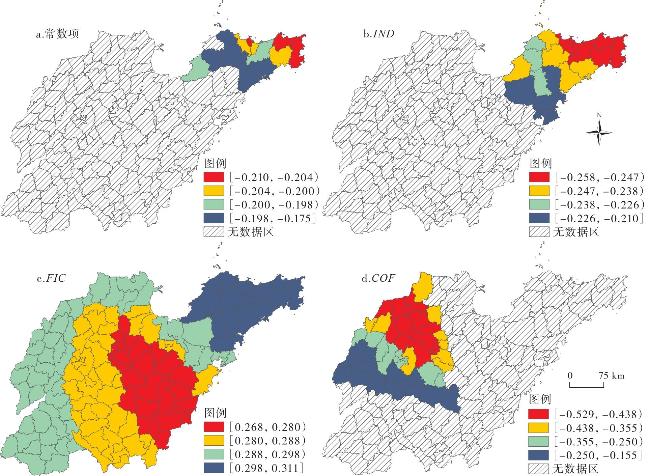
Under the background of highly uncertain environments, understanding how county-level economies respond to shocks of different attributes is critical for fostering stable and high-quality regional development. This paper takes the county-level economic units of Shandong Province as the research subjects, and constructs a resistance index to reflect the county-level economic resilience under two distinct shocks: the 2008 financial crisis and the COVID-19 pandemic. With the help of multi-scale geographically weighted regression model, this paper explores the differences in the influence mechanisms of county-level economic resilience under different attribute shocks and the spatial heterogeneity of its influencing factors. The results show that: 1) The county-level economic resistance of Shandong Province shows heterogeneity characteristics under different attribute shocks. The overall economy and different industries' ability to resist financial crises in the county-level economy of Shandong Province is lower than the national average. However, the overall economy and the tertiary industry to resist the COVID-19 pandemic is higher than the national average. 2) Agency-based factors play a significant role in promoting regional economic resilience under different attribute shocks, but the scale of their effects varies greatly. Local fiscal support has spatial heterogeneity under the financial crisis, while it has a global role in the COVID-19 pandemic. Pandemic control and governance has significant spatial heterogeneity characteristics. 3) Structural factors have different effects on regional economic resilience under different attribute shocks. Industrial structure upgrading primarily exhibits positive spatial heterogeneity during the financial crisis, but it has a negative heterogeneity under the COVID-19 pandemic. 4) The influence scale of locational conditions varies significantly under different attribute shocks. This paper suggests that the attribute and spatial heterogeneity of different shocks should be considered in analyzing the characteristics and influence mechanism of regional economic resilience.
LI Liangang , GUO Hui , ZHANG Pingyu , CHENG Yu . County-level Economic Resilience Level in Shandong Province and Its Influencing Factors under the Background of Different Attribute Shocks[J]. Economic geography, 2025 , 45(7) : 66 -76 . DOI: 10.15957/j.cnki.jjdl.2025.07.007
表1 变量及说明Tab.1 Variables and descriptions |
| 变量 | 定义 |
|---|---|
| 区域经济韧性 | 抵抗力指数 |
| 产业结构高级化(IND) | 第三产业增加值/第二产业增加值 |
| 对外开放(OPE) | 出口总额/GDP |
| 宏观调控(FIC) | 地方财政支出/GDP |
| 疫情治理(COF) | 新冠肺炎本土确诊人数(对数处理) |
| 金融环境状况(FIN) | 金融机构贷款余额/GDP |
| 消费市场状况(CNS) | 社会消费品销售总额/GDP |
| 教育状况(EDU) | 普通中学专任教师数(对数处理) |
| 经济发展状况(RGDP) | 人均GDP(对数处理) |
表2 回归系数统计描述Tab.2 Statistical description of regression coefficient |
| 2007—2019 | 2019—2020 | ||||||
|---|---|---|---|---|---|---|---|
| OLS | MGWR | OLS | MGWR | ||||
| 回归系数 | 带宽 | 均值 | 回归系数 | 带宽 | 均值 | ||
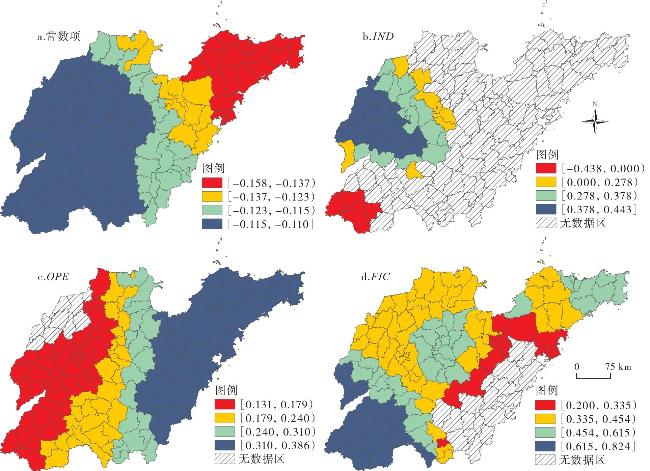
| 常数项 | 0.000 | 135 | -0.120 | 0.000 | 129 | -0.049 | |
| IND | 0.078 | 44 | 0.094 | 0.071 | 109 | -0.028 | |
| OPE | 0.233*** | 125 | 0.241 | 0.018 | 131 | -0.020 | |
| FIC | 0.390*** | 56 | 0.427 | 0.286** | 135 | 0.288 | |
| COF | -0.081 | 76 | -0.094 | ||||
| FIN | 0.258*** | 50 | 0.212 | 0.065 | 132 | 0.101 | |
| CNS | 0.166 | 135 | 0.154 | -0.002 | 109 | 0.060 | |
| RGDP | -0.205 | 133 | -0.110 | 0.146 | 47 | 0.204 | |
| EDU | -0.040 | 135 | -0.053 | 0.089 | 135 | 0.101 | |
| R2 | 0.472 | 0.738 | 0.069 | 0.359 | |||
| logL | -149.582 | -102.016 | -188.123 | -162.787 | |||
| AIC | 315.163 | 256.410 | 394.247 | 372.327 | |||
注:***、**、*分别表示P<0.01,P<0.05,P<0.10。 |
| [1] |
|
| [2] |
|
| [3] |
|
| [4] |
|
| [5] |
李连刚, 张平宇, 程钰, 等. 黄河流域经济韧性时空演变与影响因素研究[J]. 地理科学, 2022, 42(4):557-567.
|
| [6] |
蒋正云, 刘庆芳, 宋金平. 中国区域经济韧性的格局特征及演化机制[J]. 经济地理, 2023, 43(6):1-12.
|
| [7] |
|
| [8] |
|
| [9] |
胡晓辉, 张文忠. 制度演化与区域经济弹性——两个资源枯竭型城市的比较[J]. 地理研究, 2018, 37(7):1308-1319.
|
| [10] |
|
| [11] |
|
| [12] |
|
| [13] |
|
| [14] |
李连刚, 张平宇, 谭俊涛, 等. 韧性概念演变与区域经济韧性研究进展[J]. 人文地理, 2019, 34(2):1-7,151.
|
| [15] |
|
| [16] |
许吉黎, 张虹鸥, 陈奕嘉, 等. 演化经济地理学的理论脉络演进与研究议题展望[J]. 地理研究, 2023, 42(9):2433-2450.
|
| [17] |
李博, 曲艺. 中国沿海地区产业演化路径依赖及突破对区域经济韧性的影响[J]. 地理学报, 2023, 78(4):824-839.
|
| [18] |
|
| [19] |
|
| [20] |
谭俊涛, 赵宏波, 刘文新, 等. 中国区域经济韧性特征与影响因素分析[J]. 地理科学, 2020, 40(2):173-181.
|
| [21] |
林耿, 徐昕, 杨帆. 佛山市产业专业化、多样化与经济韧性的关系研究[J]. 地理科学, 2020, 40(9):1493-1504.
|
| [22] |
沈体雁, 于瀚辰, 周麟, 等. 北京市二手住宅价格影响机制——基于多尺度地理加权回归模型(MGWR)的研究[J]. 经济地理, 2020, 40(3):75-83.
|
| [23] |
李连刚, 胡晓辉. 新冠肺炎疫情下中国区域经济韧性时空格局与影响因素分析[J]. 世界地理研究, 2023, 32(3):64-75.
|
| [24] |
狄乾斌, 陈科其, 陈小龙. 疫情冲击下北京市旅游业经济韧性测度及其影响因素[J]. 经济地理, 2023, 43(1):133-140.
|
| [25] |
谭燕芝, 海霞, 张文哲. 中部地区县域经济韧性空间分异及其驱动因素[J]. 经济地理, 2023, 43(11):17-24,35.
|
| [26] |
贺灿飞, 胡绪千. 1978年改革开放以来中国工业地理格局演变[J]. 地理学报, 2019, 74(10):1962-1979.
|
| [27] |
孙久文, 陈超君, 孙铮. 黄河流域城市经济韧性研究和影响因素分析——基于不同城市类型的视角[J]. 经济地理, 2022, 42(5):1-10.
|
| [28] |
袁保瑚, 李继伟. 新发展格局下山东省县域经济高质量发展路径研究[J]. 山东社会科学, 2021, 35(8):115-123.
|
| [29] |
|
| [30] |
|
| [31] |
|
| [32] |
|
| [33] |
杜志威, 文志敏, 金利霞. “结构—能动性”框架下短期经济韧性的动态演化与影响机制——基于新冠肺炎疫情冲击下对东莞企业的访谈[J]. 热带地理, 2022, 42(8):1217-1227.
|
| [34] |
贺灿飞, 盛涵天. 区域经济韧性:研究综述与展望[J]. 人文地理, 2023, 38(1):1-10.
|
| [35] |
彭荣熙, 刘涛, 曹广忠. 中国东部沿海地区城市经济韧性的空间差异及其产业结构解释[J]. 地理研究, 2021, 40(6):1732-1748.
|
| [36] |
方叶林, 王秋月, 黄震方, 等. 中国旅游经济韧性的时空演化及影响机理研究[J]. 地理科学进展, 2023, 42(3):417-427.
|
| [37] |
|
| [38] |
宗会明, 张嘉敏, 刘绘敏. COVID-19疫情冲击下的中国对外贸易韧性格局及影响因素[J]. 地理研究, 2021, 40(12):3349-3363.
|
| [39] |
钟茂初. “有为政府”在市场经济发展中的作用机理[J]. 人民论坛, 2021(36):42-45.
|
| [40] |
|
/
| 〈 |
|
〉 |