


Local and Tele-coupling Coordination of Urbanization and Ecosystem Health in the Central Yunnan Urban Agglomeration
Received date: 2023-12-21
Revised date: 2024-07-25
Online published: 2025-06-24
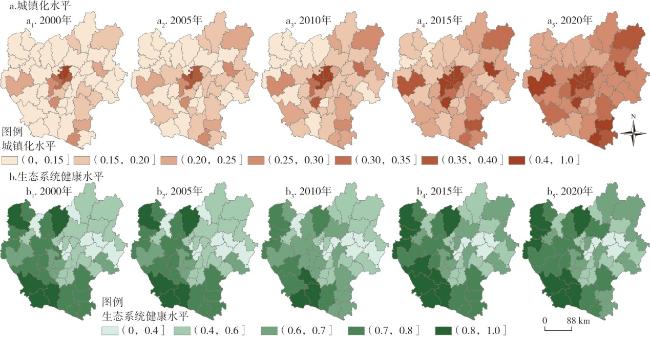
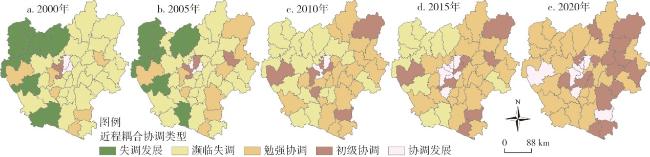
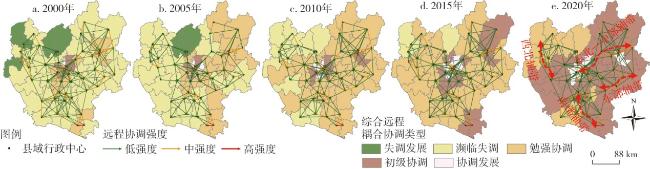
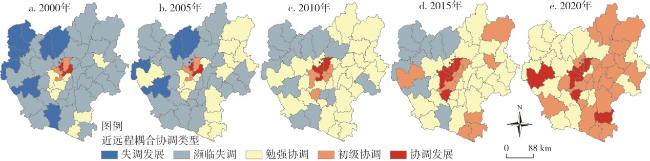
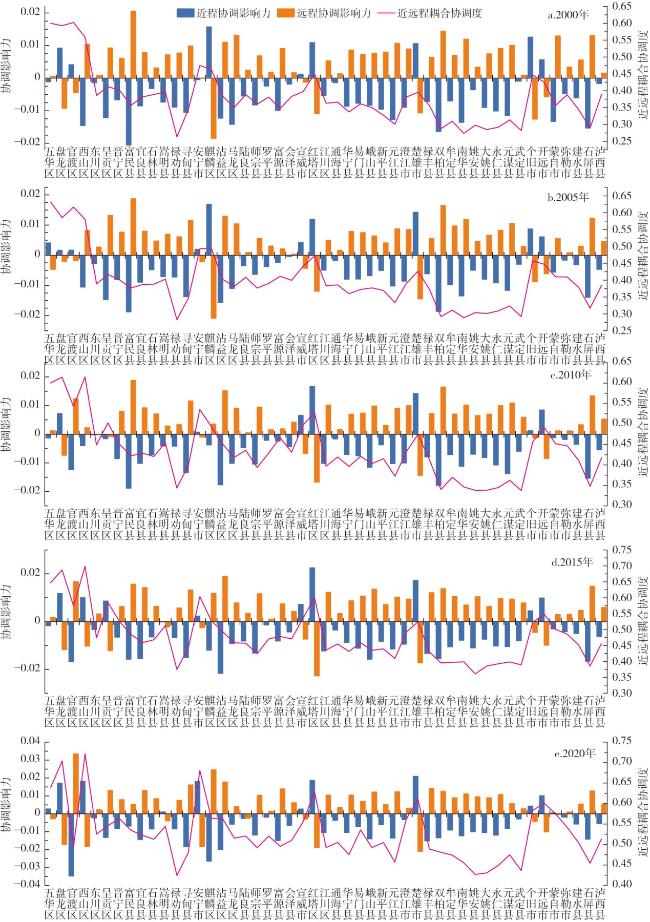
Taking the Central Yunnan Urban Agglomeration as a case study, this study constructs a framework for analyzing local and tele-coupling coordination relationships between urbanization and ecosystem health based on the "pattern-process" research approach. The findings reveal the following: 1) From 2000 to 2020, the level of urbanization showed continuous improvement in the Central Yunnan Urban Agglomeration, while ecosystem health initially deteriorated and later improved. Spatially, the two systems exhibited a dislocated pattern, with urbanization characterized by "high in the east of the Central Yunnan Urban Agglomeration and low in the west of the Central Yunnan Urban Agglomeration" and ecosystem health displaying the opposite trend of "high in the west of the Central Yunnan Urban Agglomeration and low in the east of the Central Yunnan Urban Agglomeration". 2) The local coupling coordination between urbanization and ecosystem health has gradually strengthened, with the main urban area of Kunming serving as the high-value core, radiating outward to the periphery, demonstrating a pronounced polarization effect. Simultaneously, the function of tele-coupling coordination has also improved, resulting in four telecoupling coordination axes with relatively balanced spatial distribution. 3) The degree of local and tele-coupling coordination between urbanization and ecosystem health has increased, transitioning from near imbalance to primary coordination. This trend features high-value clusters centered around regional central cities, with diffusion along the tele-coupling coordination axes. The influence of tele-coupling coordination has been growing, significantly supporting overall regional coupling and coordination. Differences in local and tele-coupling coordination effects are observed between core and peripheral areas, with peripheral areas relying more on tele-coupling coordination. Based on these findings, this study proposes spatially differentiated regulatory strategies that emphasize tele-coupling coordination, aiming to provide practical references for the coordinated development of urban agglomeration and ecosystem health.
LI Chen , WU Yingmei , GAO Binpin , WU Yan , WANG Mengjiao , ZHEN Kejun . Local and Tele-coupling Coordination of Urbanization and Ecosystem Health in the Central Yunnan Urban Agglomeration[J]. Economic geography, 2025 , 45(4) : 157 -167 . DOI: 10.15957/j.cnki.jjdl.2025.04.015
表1 区域城镇化水平评价指标及其权重Tab.1 Evaluation indicators of urbanization level of the Central Yunnan Urban Agglomeration and their weights |
| 目标层 | 维度层 | 指标层 | 权重 | 指标 性质 |
|---|---|---|---|---|
| 城 镇 化 水 平 | 经济 城镇化 | 人均GDP(元/人) | 0.0768 | + |
| 二三产业占比(%) | 0.0971 | + | ||
| 人均财政收入(元/人) | 0.0759 | + | ||
| 固定资产投资(亿元) | 0.0680 | + | ||
| 人口 城镇化 | 城镇人口比重(%) | 0.0694 | + | |
| 城镇人口密度(人/km2) | 0.0810 | + | ||
| 城镇人口规模(万人) | 0.0788 | + | ||
| 空间 城镇化 | 建设用地规模(km2) | 0.0749 | + | |
| 人均建设用地面积(km2/人) | 0.0734 | + | ||
| 建设用地夜间灯光均值 | 0.0793 | + | ||
| 社会 城镇化 | 万人拥有医疗床位数(张/万人) | 0.0788 | + | |
| 中小学生人数(人) | 0.0739 | + | ||
| 人均社会消费品零售额(万元/人) | 0.0726 | + |
表2 不同土地利用类型生态系统抵抗力、恢复力及生态系统服务系数Tab.2 Ecosystem resistance,resilience and ecosystem service coefficients of different land use types |
| 类型 | 耕地 | 林地 | 草地 | 水域 | 建设用地 | 未利用地 |
|---|---|---|---|---|---|---|
| 生态系统抵抗力 | 0.4 | 0.9 | 0.7 | 0.8 | 0.2 | 0.1 |
| 生态系统恢复力 | 0.6 | 1.0 | 0.6 | 0.8 | 0.3 | 0.2 |
| 生态系统服务系数 | 0.218 | 1.000 | 0.632 | 1.000 | 0.015 | 0.070 |
表3 不同土地利用类型生态系统服务功能的空间邻域效应系数矩阵Tab.3 Matrix of spatial neighborhood effect coefficients for ecosystem service functions of different land use types |
| 邻域生态系统 | 中心生态系统 | |||||
|---|---|---|---|---|---|---|
| 耕地 | 林地 | 草地 | 水域 | 建设用地 | 未利用地 | |
| 耕地 | 3 | -1 | -1 | -4 | 1 | -1 |
| 林地 | 5 | 5 | 5 | 5 | 4 | 4 |
| 草地 | 2 | 3 | 4 | 3 | 2 | 3 |
| 水域 | 4 | 5 | 4 | 5 | 4 | 4 |
| 建设用地 | -3 | -3 | -3 | -5 | 2 | -2 |
| 未利用地 | -2 | -1 | -2 | -3 | -1 | 1 |
表4 耦合协调发展类型Tab.4 Types of coupling coordination |
| 耦合协调度 | 类型 | 耦合协调度 | 类型 |
|---|---|---|---|
| (0.0,0.3] | 失调发展 | (0.5,0.6] | 初级协调 |
| (0.3,0.4] | 濒临失调 | (0.6,1.0] | 协调发展 |
| (0.4,0.5] | 勉强协调 |
| [1] |
方创琳. 改革开放40年来中国城镇化与城市群取得的重要进展与展望[J]. 经济地理, 2018, 38(9):1-9.
|
| [2] |
吴健生, 马洪坤, 彭建. 基于“功能节点—关键廊道”的城市生态安全格局构建——以深圳市为例[J]. 地理科学进展, 2018, 37(12):1663-1671.
|
| [3] |
|
| [4] |
方创琳, 周成虎, 顾朝林, 等. 特大城市群地区城镇化与生态环境交互耦合效应解析的理论框架及技术路径[J]. 地理学报, 2016, 71(4):531-550.
|
| [5] |
|
| [6] |
|
| [7] |
方创琳, 崔学刚, 梁龙武. 城镇化与生态环境耦合圈理论及耦合器调控[J]. 地理学报, 2019, 74(12):2529-2546.
|
| [8] |
刘海猛, 方创琳, 李咏红. 城镇化与生态环境“耦合魔方”的基本概念及框架[J]. 地理学报, 2019, 74(8):1489-1507.
|
| [9] |
郝智娟, 文琦, 施琳娜, 等. 黄河流域城市群社会经济与生态环境耦合协调空间网络分析[J]. 经济地理, 2023, 43(12):181-191.
|
| [10] |
孙晶, 刘建国, 杨新军, 等. 人类世可持续发展背景下的远程耦合框架及其应用[J]. 地理学报, 2020, 75(11):2408-2416.
|
| [11] |
马恩朴, 蔡建明, 韩燕, 等. 人地系统远程耦合的研究进展与展望[J]. 地理科学进展, 2020, 39(2):310-326.
|
| [12] |
|
| [13] |
|
| [14] |
|
| [15] |
|
| [16] |
任宇飞, 方创琳, 李广东, 等. 城镇化与生态环境近远程耦合关系研究进展[J]. 地理学报, 2020, 75(3):589-606.
|
| [17] |
刘建国,
|
| [18] |
|
| [19] |
|
| [20] |
|
| [21] |
朱竑, 陈晓亮, 尹铎. 从“绿水青山”到“金山银山”:欠发达地区乡村生态产品价值实现的阶段、路径与制度研究[J]. 管理世界, 2023, 39(8):74-91.
|
| [22] |
冯德东, 龙花楼, 张聪, 等. 远程耦合视角下拓展脱贫攻坚成果同乡村振兴有效衔接的逻辑机理与关键维度[J]. 经济地理, 2025, 45(1):153-165.
|
| [23] |
周伟奇, 王坤, 虞文娟, 等. 城市与区域生态关联研究进展[J]. 生态学报, 2017, 37(15):5238-5245.
|
| [24] |
|
| [25] |
王少剑, 崔子恬, 林靖杰, 等. 珠三角地区城镇化与生态韧性的耦合协调研究[J]. 地理学报, 2021, 76(4):973-991.
|
| [26] |
黄泰, 卫嫚, 席建超. 长三角乡村旅游典型县新型城镇化与乡村共同富裕的共生演进的实证分析[J]. 经济地理, 2024, 44(6):213-223.
|
| [27] |
|
| [28] |
|
| [29] |
|
| [30] |
袁毛宁, 刘焱序, 王曼, 等. 基于“活力—组织力—恢复力—贡献力”框架的广州市生态系统健康评估[J]. 生态学杂志, 2019, 38(4):1249-1257.
|
| [31] |
|
| [32] |
王淑佳, 孔伟, 任亮, 等. 国内耦合协调度模型的误区及修正[J]. 自然资源学报, 2021, 36(3):793-810.
|
| [33] |
|
| [34] |
杜贺秋, 于铄, 张蓬涛, 等. 京津冀地区水源涵养价值流动分析及生态补偿额度[J]. 生态学报, 2022, 42(23):9871-9885.
|
| [35] |
|
| [36] |
孙东琪, 刘卫东, 陈明星. 点—轴系统理论的提出与在我国实践中的应用[J]. 经济地理, 2016, 36(3):1-8.
|
/
| 〈 |
|
〉 |