


Temporal and Spatial Differentiation of Tourism Economy-Ecological Efficiency and Its Influencing Factors in Wuling Mountain Area
Received date: 2019-10-14
Revised date: 2020-03-02
Online published: 2025-05-14
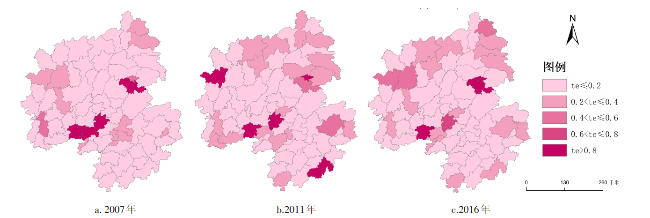
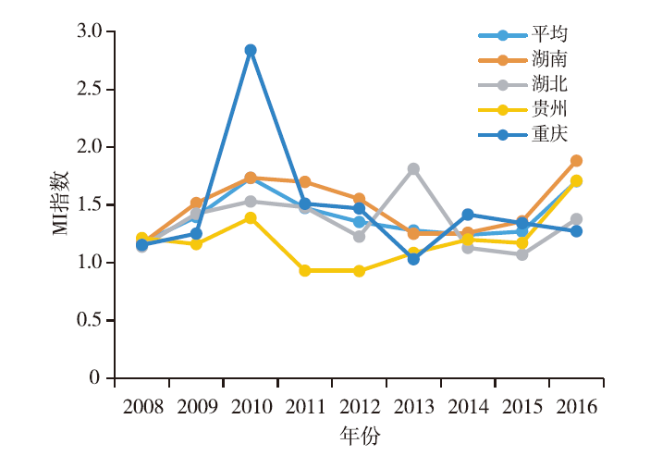
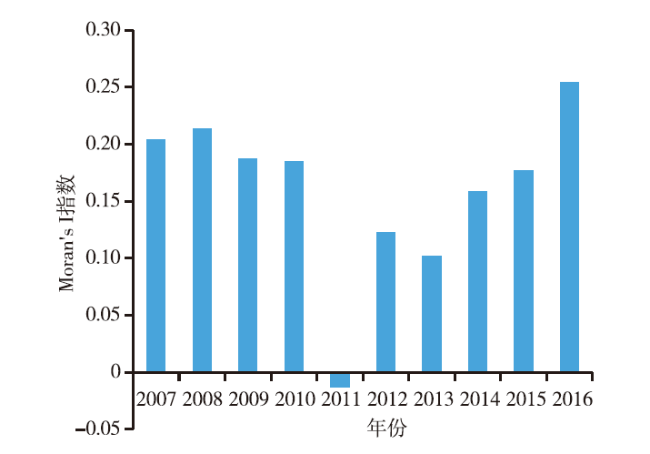
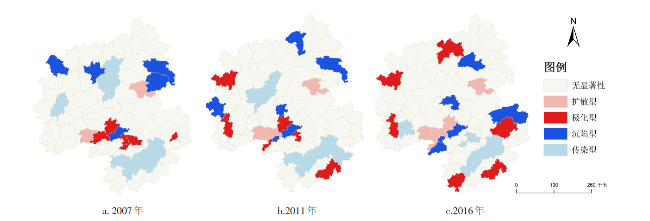
The study of tourism ecological efficiency has become a new direction of tourism sustainable development. Taking Wuling Mountain Area as the research object, DEA method was used to measure the regional tourism economy-ecological efficiency. The results showed that the overall level of regional comprehensive efficiency was low,the polarization was serious,but the non-equilibrium tended to decrease gradually. MI index shows that the efficiency is in a rapid development stage as a whole during the research period,and the timing pattern is in the shape of "S". ESDA method was used to study the spatial and temporal differentiation characteristics of the elements. The global correlation was shown as "aggregation-random-aggregation process",showing a "U"-shaped change trend. The local correlation index shows that the overall spatial correlation is weak and tends to be balanced from polarization. The influence factor analysis model was established,and the results showed that the research factors were greatly affected by economic factors,while the ecological and environmental factors were less. Economic factors have less influence on economically developed regions than less developed regions,and ecological factors have more influence on economically developed regions than less developed regions.
LI Zhilong , WANG Diyun . Temporal and Spatial Differentiation of Tourism Economy-Ecological Efficiency and Its Influencing Factors in Wuling Mountain Area[J]. Economic geography, 2020 , 40(6) : 233 -240 . DOI: 10.15957/j.cnki.jjdl.2020.06.025
表1 旅游经济—生态效率评价指标体系Tab.1 Tourism economy-ecological efficiency evaluation index system |
| 指标 | 类别 | 内容 |
|---|---|---|
| 投入指标 | 经济指标 | 旅游固定资产投资 |
| 旅游业从业人数 | ||
| 旅游资源 | ||
| 旅游设施投入 | ||
| 生态指标 | 旅游环境治理投入资本 | |
| 旅游能源消耗(万t标准煤) | ||
| 产出指标 | 期望产出 | 旅游收入 |
| 非期望产出 | 旅游污染物排放 |
表2 旅游经济—生态综合效率统计特征Tab.2 Statistical characteristics of tourism economy-ecological comprehensive efficiency |
| 2007 | 2008 | 2009 | 2010 | 2011 | 2012 | 2013 | 2014 | 2015 | 2016 | |
|---|---|---|---|---|---|---|---|---|---|---|
| 均值 | 0.159 | 0.162 | 0.185 | 0.153 | 0.209 | 0.196 | 0.226 | 0.240 | 0.195 | 0.195 |
| 标准差 | 0.212 | 0.217 | 0.229 | 0.201 | 0.238 | 0.202 | 0.238 | 0.241 | 0.218 | 0.203 |
| 变异系数 | 1.333 | 1.346 | 1.239 | 1.315 | 1.138 | 1.028 | 1.055 | 1.005 | 1.118 | 1.039 |
| te≤0.2 | 55 | 55 | 49 | 62 | 47 | 50 | 41 | 40 | 48 | 48 |
| 0.2<te≤0.4 | 10 | 10 | 13 | 3 | 17 | 13 | 20 | 19 | 17 | 16 |
| 0.4<te≤0.6 | 2 | 2 | 5 | 1 | 2 | 4 | 4 | 5 | 2 | 3 |
| 0.6<te≤0.8 | 0 | 0 | 1 | 3 | 0 | 2 | 2 | 3 | 1 | 1 |
| te>0.8 | 4 | 4 | 3 | 2 | 5 | 2 | 4 | 4 | 3 | 3 |
表3 空间关联类型县域单元数量分布(单位:个)Tab.3 Spatial association type number distribution of county units |
| 2007 | 2008 | 2009 | 2010 | 2011 | 2012 | 2013 | 2014 | 2015 | 2016 | |
|---|---|---|---|---|---|---|---|---|---|---|
| 扩散型 | 3 | 3 | 4 | 3 | 4 | 4 | 5 | 4 | 4 | 6 |
| 极化型 | 5 | 5 | 5 | 6 | 6 | 6 | 5 | 6 | 6 | 6 |
| 沉陷型 | 5 | 6 | 6 | 6 | 5 | 5 | 6 | 6 | 6 | 6 |
| 传染型 | 9 | 9 | 9 | 6 | 7 | 7 | 8 | 7 | 6 | 5 |
| 不显著 | 49 | 48 | 48 | 48 | 49 | 49 | 47 | 48 | 49 | 48 |
表4 协整关系参数值Tab.4 Cointegration relation parameter values |
| 整个片区 | 湖南片区 | 湖北片区 | 贵州片区 | 重庆片区 | |
|---|---|---|---|---|---|
| lnTPF | 1.000000 | 1.000000 | 1.000000 | 1.000000 | 1.000000 |
| lnGDP | -0.434046*** | -0.475402*** | -0.425976** | -0.684503** | -0.380673*** |
| lnIS | -0.085821*** | -0.085767** | -0.084956*** | -0.083671** | -0.085743*** |
| lnRE | -0.137228** | -0.217253** | -0.133218** | -0.135620* | -0.116543** |
| lnInf | -0.180954** | -0.388243** | -0.534068*** | -1.129266** | -0.234046*** |
| lnER | -0.056732** | -0.055783** | -0.058409** | -0.053762** | -0.068702** |
注:本结果由Eviews8.0计算得出;***、**、*分别表示1%、5%和10%的水平下显著。 |
| [1] |
|
| [2] |
马晓龙. 国内外旅游效率研究进展与趋势综述[J]. 人文地理, 2012, 27(3):11-17.
|
| [3] |
徐冬, 黄震芳, 胡小海, 等. 浙江省县域旅游效率空间格局演变及影响因素[J]. 经济地理, 2018, 38(5):197-207.
|
| [4] |
方叶林, 黄震方, 李东和, 等. 中国省域旅游业发展效率测度及其时空演化[J]. 经济地理, 2015, 35(8):189-195.
|
| [5] |
|
| [6] |
姚治国, 陈田, 尹寿兵, 等. 区域旅游生态效率实证分析——以海南省为例[J]. 地理科学, 2016, 36(3):417-423.
|
| [7] |
|
| [8] |
彭薇, 熊科. 环境压力视角的广东省市域生态效率综合评价[J]. 经济地理, 2018, 38(8):179-186.
|
| [9] |
佟连军, 宋亚楠, 韩瑞玲, 等. 辽宁沿海经济带工业环境效率分析[J]. 地理科学, 2012, 32(3):294-300.
|
| [10] |
|
| [11] |
彭红松, 章锦河, 韩娅, 等. 旅游地生态效率测度的SBM-DEA模型及实证分析[J]. 生态学报, 2017, 37(2):628-638.
|
| [12] |
姚治国, 陈田. 旅游生态效率研究进展[J]. 旅游科学, 2016, 30(6):74-91.
|
| [13] |
|
| [14] |
曹芳东, 黄震方, 吴江, 等. 国家级风景名胜区旅游效率测度与区位可达性分析[J]. 地理学报, 2012, 67(12):1686-1 697.
|
| [15] |
郭露, 徐诗倩. 基于超效率DEA的工业生态效率——以中部六省2003—2013年数据为例[J]. 经济地理, 2016, 36(6):116-121.
|
| [16] |
|
| [17] |
|
| [18] |
马晓龙. 2000—2011年中国主要旅游城市全要素生产率评价[J]. 资源科学, 2014, 36(8):1626-1 634.
|
| [19] |
|
/
| 〈 |
|
〉 |