


Spatial Structure and Evolution of Tea Trade in the World from 1946 to 2016
Received date: 2019-11-23
Revised date: 2020-06-26
Online published: 2025-04-18
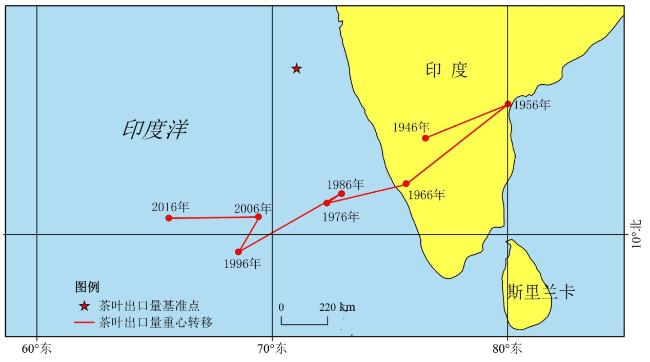
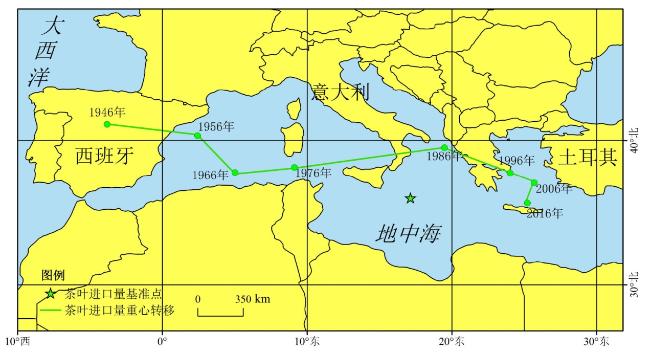
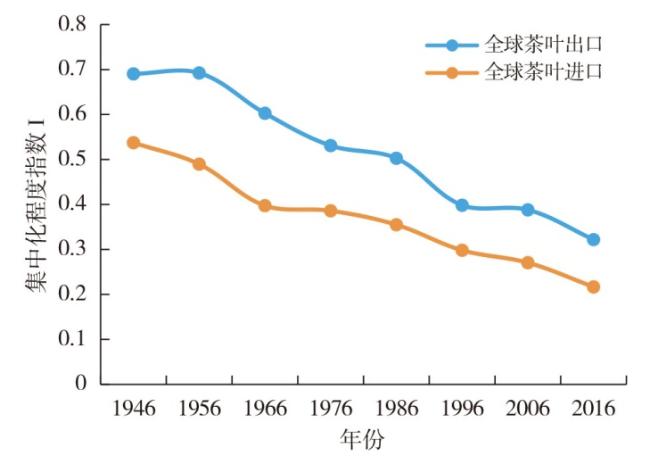
It is of great significance for the strategic decision-making of the world tea industry to study the spatial change characteristics of the pattern of tea trade. By using GIS technology, gravity center theory and Gini coefficient, the spatial distribution characteristics,moving track of gravity center and its centralization degree of world tea import and world tea export from 1946 to 2016 are analyzed. The driving factors of spatial evolution are discussed. The results show that: 1) The world tea exports show a clear westward trend,while the world tea imports show a clear eastward trend. 2) On the map of the center of gravity transfer path,the global tea import center of gravity has moved eastward faster than the tea outlet center of gravity moved westward in the past 70 years. 3) The Gini coefficient of global tea import and export trades has shown a downward trend in the past 70 years. 4) The export gap of producing countries will be further narrowed under the background of the increasing number of tea producing countries and the intensifying competition in tea export,and the import gap of consuming countries will be further narrowed under the background of economic globalization and the continuous improvement of the consumption level of each country.
JU Xiang , XIAO Zhi . Spatial Structure and Evolution of Tea Trade in the World from 1946 to 2016[J]. Economic geography, 2020 , 40(8) : 123 -130 . DOI: 10.15957/j.cnki.jjdl.2020.08.015
表1 1946—2016年全球茶叶出口量与茶叶进口量重心转移距离Tab.1 Moving distance of the tea exportation volume and the tea importation volume gravity center in the world from 1946 to 2016 |
| 年份 | 茶叶出口量空间位置 | 移动距离 (km) | 茶叶进口量空间位置 | 移动距离 (km) | |||||
|---|---|---|---|---|---|---|---|---|---|
| 东经 | 北纬 | 东经 | 北纬 | ||||||
| 基准点 | 71°04′34.51″ | 17°04′79.76″ | - | 17°13′28.00″ | 36°01′72.31″ | - | |||
| 1946 | 76°51′34.53″ | 14°06′87.83″ | 692.07 | -3°82′30.31″ | 41°11′55.44″ | 2 396.32 | |||
| 1956 | 80°02′13.50″ | 15°50′69.42″ | 421.25 | 2°42′43.30″ | 40°33′26.94″ | 699.57 | |||
| 1966 | 75°68′93.77″ | 12°14′03.04″ | 609.59 | 5°01′68.23″ | 37°77′98.26″ | 404.27 | |||
| 1976 | 72°32′30.69″ | 11°32′06.43″ | 384.96 | 9°11′50.82″ | 38°13′77.60″ | 457.09 | |||
| 1986 | 72°94′98.98″ | 11°72′04.53″ | 82.61 | 19°48′92.08″ | 39°51′00.71″ | 1 162.71 | |||
| 1996 | 68°56′50.56″ | 9°25′13.00″ | 559.13 | 24°01′87.94″ | 37°74′09.43″ | 540.31 | |||
| 2006 | 69°41′81.04″ | 10°73′85.22″ | 190.50 | 25°68′36.53″ | 37°06′71.66″ | 199.56 | |||
| 2016 | 65°60′33.23″ | 10°68′55.06″ | 423.90 | 25°21′33.75″ | 35°65′84.29″ | 165.02 | |||
图5 1946—2016年全球茶叶出口量重心转移路径Fig.5 Dynamic evolution of the tea exportation volume gravity centers in the world from 1946 to 2016 |
| [1] |
|
| [2] |
顾国达, 牛晓婧, 张钱江. 技术壁垒对国际贸易影响的实证分析——以中日茶叶贸易为例[J]. 国际贸易问题, 2007(6):74-80.
|
| [3] |
李晓钟, 张小蒂. 我国茶叶贸易基于标准化生产增进比较利益的分析[J]. 农业经济问题, 2009(3):87-92.
|
| [4] |
苏祝成, 许咏梅. 中国茶叶贸易对国际市场茶叶价格影响的实证分析[J]. 农业经济问题, 2008(4):10-14.
|
| [5] |
韩文炎. 斯里兰卡的茶叶贸易[J]. 中国茶叶, 2000(4):10-11.
|
| [6] |
牛晓婧, 顾国达, 张纯. 全球茶叶生产与贸易格局的演变及现状分析[J]. 全球农业, 2007(6):29-32.
|
| [7] |
潘启龙, 刘合光, 杨秀平. 中国茶叶出口格局与展望[J]. 农业展望, 2011, 7(2):50-55.
|
| [8] |
张丽艳. 中国茶叶贸易变动趋势与前景展望[J]. 全球农业, 2011(7):46-49.
|
| [9] |
夏昕鸣, 贺灿飞. 贸易保护视角下中国出口导向型外资企业产品演化[J]. 经济地理, 2019, 39(04):109-117.
|
| [10] |
钱文荣. 评《中国“四化”同步发展时空演化格局、形成机理与模式选择研究》[J]. 经济地理, 2018, 38(7):42.
|
| [11] |
肖智, 黄贤金, 孟浩, 等. 2009—2014年中国茶叶生产空间演变格局及变化特征[J]. 地理研究, 2017, 36(1):109-120.
|
| [12] |
李在军, 管卫华, 柯文前. 中国区域消费与经济、人口重心演变的时间多尺度研究[J]. 经济地理, 2014, 34(1):7-14.
|
| [13] |
林思宇, 王良健, 马中. 1990年以来湖南人口与经济重心及其演化[J]. 经济地理, 2014, 34(10):31-38.
|
| [14] |
陈志刚, 王青, 黄贤金, 等. 长三角城市群重心移动及其驱动因素研究[J]. 地理科学, 2007, 27(4):457-462.
|
| [15] |
张兴榆, 黄贤金, 赵雲泰, 等. 近10年江苏省土地利用重心与经济重心迁移轨迹对比分析[J]. 长江流域资源与环境, 2011, 20(1):14-20.
|
| [16] |
王彬, 王宜强. 改革开放以来福建省经济重心格局演变及其空间差异[J]. 地理研究, 2011, 30(10):1882-1890.
|
| [17] |
原嫄, 李国平, 孙铁山, 等. 中国制造业重心的空间分布变化特征与趋势研究:基于2001年和2009年数据的实证分析[J]. 人文地理, 2015, 29(5):99-105.
|
| [18] |
任志远, 李强. 1978年以来中国能源生产与消费时空差异特征[J]. 地理学报, 2008, 63(12):1318-1326.
|
| [19] |
张敏, 顾朝林. 近期中国省际经济社会要素流动的空间特征[J]. 地理研究, 2002, 21(3):313-323.
|
| [20] |
李二玲, 庞安超, 朱纪广. 中国农业地理集聚格局演化及其机制[J]. 地理研究, 2012, 31(5):885-898.
|
| [21] |
孙磊, 张晓平. 北京制造业空间布局演化及重心变动分解分析[J]. 地理科学进展, 2012, 31(4):491-497.
|
| [22] |
关伟, 许淑婷. 辽宁省能源效率与产业结构的空间特征及耦合关系[J]. 地理学报, 2014, 69(4):520-530.
|
| [23] |
张耀光, 王国力, 刘锴, 等. 中国区域海洋经济差异特征及海洋经济类型区划分[J]. 经济地理, 2015, 35(9):87-95.
|
| [24] |
肖智, 黄贤金. 长江经济带茶叶生产空间格局演变[J]. 经济地理, 2017, 37(5):110-115.
|
| [25] |
张聪颖, 畅倩, 霍学喜. 中国苹果生产布局变迁分析——基于GIS技术与重心理论的应用[J]. 经济地理, 2018, 38(7):1-17.
|
| [26] |
张晓燕. 区域茶产业经济影响因素的数量经济分析[J]. 福建茶叶, 2017(2):194-195.
|
| [27] |
王国梁, 逯砚秋. 中国植茶技术的地理扩散与全球四大茶叶产区[J]. 全球地理研究, 2014, 23(1):151-157.
|
| [28] |
陈永兴. 永春高山茶园气候条件分析及高产对策[J]. 福建茶叶, 2015, 37(3):50-52.
|
| [29] |
许咏梅. 肯尼亚茶叶生产、消费、贸易[J]. 世界农业, 2012(7):89-91.
|
| [30] |
林郑和, 钟秋生, 陈常颂. 茶树抗性育种研究进展[J]. 福建茶叶, 2015, 37(4):2-4.
|
| [31] |
段灿. 中国财政支出结构与经济增长关系研究[D]. 北京: 首都经济贸易大学, 2014.
|
/
| 〈 |
|
〉 |