


The Spatial Differentiation of Urban Shadow Educational Institutions and the Territorialization of Educational Resources: A Case Study of Nanjing, China
Received date: 2020-10-11
Revised date: 2021-04-22
Online published: 2025-04-17
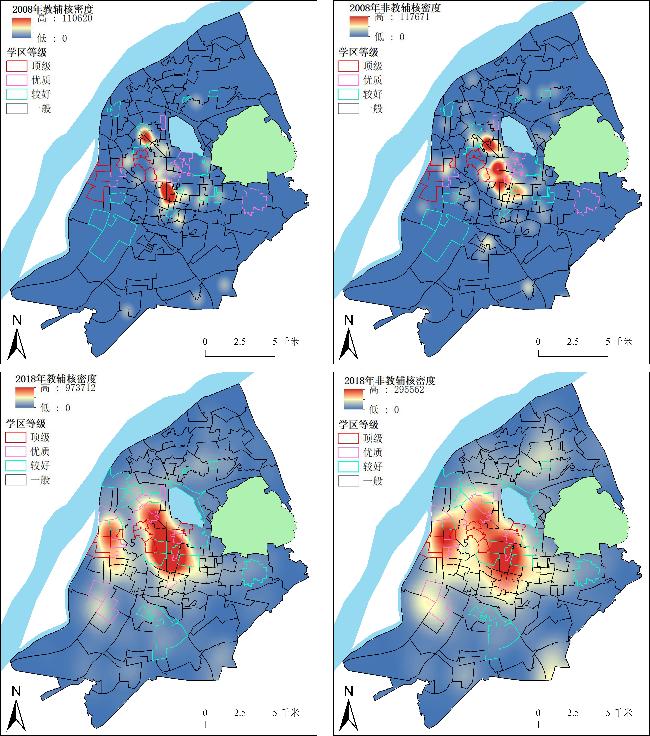
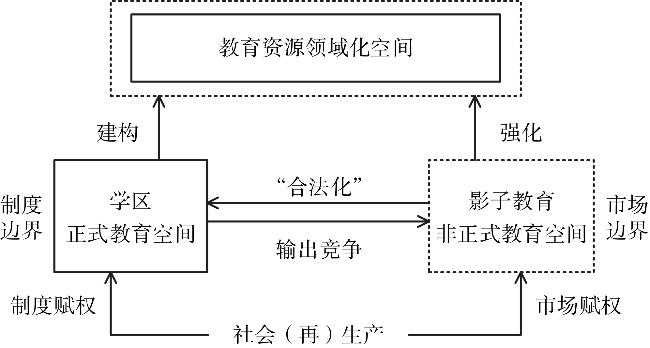
Under the background of urban social spatial differentiation, school district is often used as a tool for the (re)production of social stratification and a spatial vehicle for the territorialization of educational resources. Although many researches have revealed this process, most of them do not involve the shadow education system. This paper explores the "interaction" between the shadow education system and the formal education system, and its influence and effect on the territorialization of educational resources by studying the spatial differentiation of shadow education institutions in Nanjing's main urban area, the degree of family participation in different school districts and its difference, and the competition among families in the informal education space. It's found that: (1) Shadow education institutions are highly concentrated around elite school districts, and their kernel density decreases gradually according to the school district level. (2) There are significant differences of family investment on shadow education institutions among different school districts so that advantaged families can transform and harvest more cultural capital in shadow education institutions to gain a competitive advantage. (3) The competition-oriented educational environment drives the expansion of shadow education institutions, while their symbolic connotations drive their differentiation. Beyond the institutional boundaries of the school district, shadow education further establishes market boundaries, which consolidates and strengthens the control of the urban elite over educational resources, and finally forms a new space for the territorialization of educational resources. The new space not only exacerbates educational segregation but also gradually extends the education-gentrification space to the commercial space.
LIU Chunhui , GU Yue , LIU Yu , SONG Weixuan . The Spatial Differentiation of Urban Shadow Educational Institutions and the Territorialization of Educational Resources: A Case Study of Nanjing, China[J]. Economic geography, 2021 , 41(5) : 155 -164 . DOI: 10.15957/j.cnki.jjdl.2021.05.017
表1 2008与2018年教辅、非教辅机构的数量及其构核密度与学区等级的相关性Tab.1 The number of academic and non-academic institutions and their correlation between the kernel density and school district level in 2008 and 2018 |
| 年份 | 教辅机构 | 非教辅机构 | |||
|---|---|---|---|---|---|
| 数量(家) | 相关系数 | 数量(家) | 相关系数 | ||
| 2008 | 54 | 0.000 | 143 | 0.111 | |
| 2018 | 3 484 | 0.218** | 2 492 | 0.293** | |
注:**表示在0.01统计水平显著。 |
表2 2018年各类教辅与非教辅机构核密度与学区等级的相关性Tab.2 Correlation between the kernel density of various types of academic and non-academic institutions and school district level in 2018 |
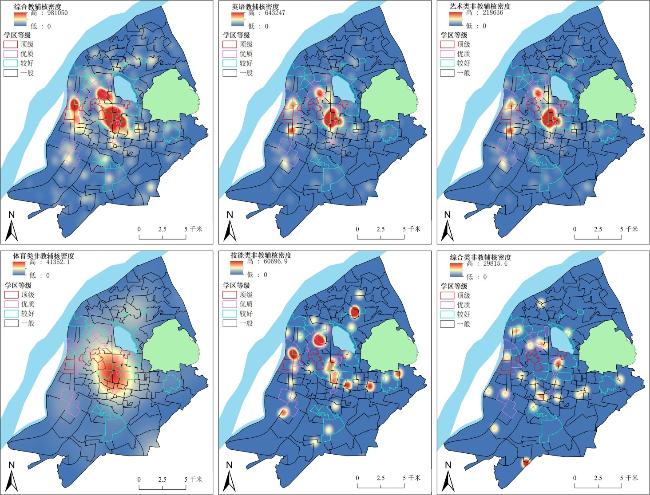
| 综合 教辅 | 英语 教辅 | 技能类 非教辅 | 艺术类 非教辅 | 体育类 非教辅 | 综合类 非教辅 | |
|---|---|---|---|---|---|---|
| 相关系数 | 0.282** | 0.137 | 0.119 | 0.355** | 0.196** | -0.062 |
注:**表示在0.01统计水平显著。 |
表3 不同等级学区家庭每学期在教辅与非教辅机构的资金投入(单位:万元)Tab. 3 The investment amount per semester of family in the different level of school districts on academic and non-academic institutions (unit: 10 000 RMB) |
| 机构分类 | 顶级 | 优质 | 较好 | 一般 |
|---|---|---|---|---|
| 教辅 | 4.09 | 4.11 | 2.07 | 0.73 |
| 非教辅 | 3.30 | 3.87 | 1.75 | 0.51 |
| 合计 | 7.39 | 7.98 | 3.82 | 1.24 |
表4 不同等级学区家庭每学期在教辅与非教辅机构的时间投入(单位:h)Tab.4 Time investment per semester of family in the different level of school districts on academic and non-academic institutions (unit: hour) |
| 时间 | 机构分类 | 顶级 | 优质 | 较好 | 一般 |
|---|---|---|---|---|---|
| 平时(每天) | 教辅 | 1.19 | 1.32 | 0.78 | 2.17 |
| 非教辅 | 0.88 | 0.91 | 0.51 | 0.21 | |
| 周末 | 教辅 | 3.14 | 4.77 | 3.01 | 1.22 |
| 非教辅 | 3.47 | 3.21 | 2.56 | 1.45 | |
| 合计 | 教辅 | 181.80 | 227.40 | 138.20 | 241.40 |
| 非教辅 | 157.40 | 155.20 | 102.20 | 50.00 |
注:不同学区家庭子女每学期在影子教育机构投入的时间总和以每学期20周计算。 |
表5 不同等级学区家庭在教辅与非教辅机构投入的单位时间成本(单位:元/h)Tab.5 Cost investment per hour of family in the different level of school districts on academic and non-academic institutions (unit: RMB/hour) |
| 机构分类 | 顶级 | 优质 | 较好 | 一般 |
|---|---|---|---|---|
| 教辅 | 225 | 181 | 150 | 30 |
| 非教辅 | 210 | 249 | 171 | 102 |
| [1] |
吴愈晓. 中国城乡居民的教育机会不平等及其演变(1978—2008)[J]. 中国社会科学, 2013(3):4-21.
|
| [2] |
袁振杰, 郭隽, 万果, 等. 中国优质基础教育资源空间格局形成机制及综合效应[J]. 地理学报, 2020, 74(2):318-331.
|
| [3] |
吴磊, 焦华富, 叶雷, 等. 中国省际教育城镇化的时空特征及影响因素[J]. 地理科学, 2018, 38(1):58-66.
|
| [4] |
宋伟轩, 涂唐奇, 尹上岗, 等. 南京义务教育资源的社会——空间可达性差异及效应研究[J]. 地理研究, 2019, 38(8):2008-2026.
|
| [5] |
刘天宝, 郑莉文, 杜鹏. 市域义务教育资源均衡水平的空间特征与分布模式——以大连市小学为例[J]. 经济地理, 2018, 38(7):67-74.
|
| [6] |
涂唐奇, 闫东升, 陈江龙, 等. 南京城市义务教育设施空间演化[J]. 地理科学, 2019, 39(3):433-441.
|
| [7] |
|
| [8] |
|
| [9] |
李春玲. 社会政治变迁与教育机会不平等——家庭背景及制度因素对教育获得的影响(1940-2001)[J]. 中国社会科学, 2003(3):86-98.
|
| [10] |
李煜. 制度变迁与教育不平等的产生机制——中国城市子女的教育获得(1966-2003)[J]. 中国社会科学, 2006(4):97-109.
|
| [11] |
戴特奇, 赵韶雅, 廖聪. 概率分布相似最大化的“就近—随机”入学机会公平优化——以北京市西城区为例[J]. 经济地理, 2019, 39(11):18-24.
|
| [12] |
陈培阳. 中国城市学区绅士化及其社会空间效应[J]. 城市发展研究, 2015, 22(8):55-60.
|
| [13] |
陈培阳. 西方城市学生化研究进展综述[J]. 人文地理, 2017, 32(1):9-15.
|
| [14] |
杨振山, 粟子林, 丁悦, 等. 学区化外部性对城市空间的影响[J]. 人文地理, 2018, 33(4):60-67.
|
| [15] |
胡述聚, 李诚固, 张婧, 等. 教育绅士化社区:形成机制及其社会空间效应研究[J]. 地理研究, 2019, 38(5):1175-1188.
|
| [16] |
刘宏燕, 陈雯. 中国基础教育资源布局研究述评[J]. 地理科学进展, 2017, 36(5):557-568.
|
| [17] |
胡咏梅, 范文凤, 丁维莉. 影子教育是否扩大教育结果的不均等——基于PISA 2012上海数据的经验研究[J]. 北京大学教育评论, 2015, 13(3):29-46.
|
| [18] |
薛海平. 从学校教育到影子教育:教育竞争与社会再生产[J]. 北京大学教育评论, 2015, 13(3):47-69.
|
| [19] |
刘云刚, 叶清露, 许晓霞. 空间, 权力与领域:领域的政治地理研究综述与展望[J]. 人文地理, 2015, 30(3):1-6.
|
| [20] |
|
| [21] |
|
| [22] |
|
| [23] |
|
| [24] |
|
| [25] |
|
| [26] |
|
| [27] |
马仁锋, 周小靖, 窦思敏. 城市教育空间的生产与消费[J]. 宁波大学学报:教育科学版, 2020, 42(6):63-72.
|
| [28] |
|
| [29] |
|
| [30] |
毕芙蓉. 文化资本与符号暴力——论布迪厄的知识社会学[J]. 理论探讨, 2015(1):53-56.
|
| [31] |
|
| [32] |
|
| [33] |
|
| [34] |
|
| [35] |
|
| [36] |
|
| [37] |
|
/
| 〈 |
|
〉 |