


Spatial Organization Network Evolution of State-owned Enterprise in Guangdong Province:An Empirical Analysis Based on Directed Weighted Network
Received date: 2021-06-01
Revised date: 2021-11-10
Online published: 2025-03-31
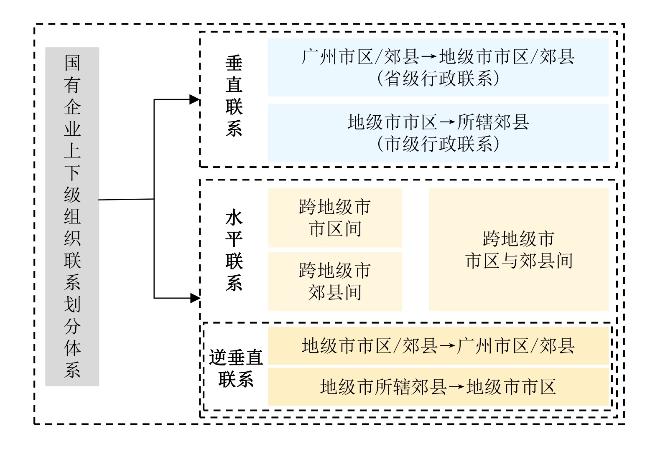
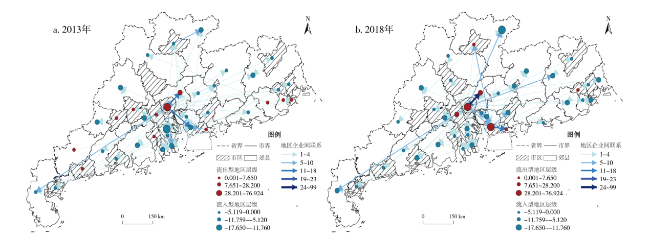
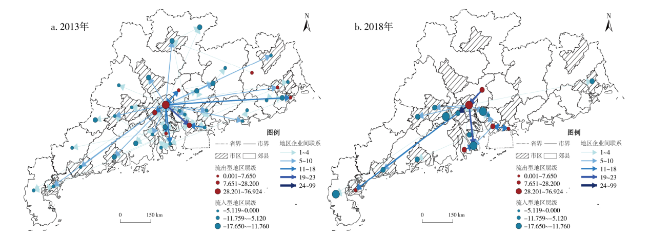
This study constructs the spatial organization network of state-owned enterprises (SOE) in Guangdong Province based on the directed flows between parent and subsidiary companies recognized from the 3rd (2013) and 4th (2018) National Economic Census. Specifically,on the basis of a classification of vertical and horizontal relationships representing institutional and market force respectively,this study demonstrates and compares the spatial organization network evolution of state-owned manufacturing and service enterprises during the period 2013-2018. The results show that: 1) In term of the evolution of overall network structure,it is increasing year by year on the network density of both manufacturing and service enterprises,but it has significant differences on their outdegree centrality and indegree centrality. 2) In term of the evolution of network spatial pattern,organization network of state-owned manufacturing and service enterprises show the characteristic of two centers which are Shenzhen and Guangzhou. Network of state-owned manufacturing enterprises shows the distribution characteristics which are one center,one belt and one zone. Network of state-owned service enterprises concentrates in the central area of the Pearl River Delta. 3) The institutional factor still dominates the spatial organization network of both state-owned manufacturing and service enterprises,the market force has become increasingly important in influencing the spatial organization network of state-owned service enterprise,while its influence on that of state-owned manufacturing enterprises becomes weak during the study period.
WANG Bo , LEI Yaqin , YI Danran , XUE Desheng . Spatial Organization Network Evolution of State-owned Enterprise in Guangdong Province:An Empirical Analysis Based on Directed Weighted Network[J]. Economic geography, 2021 , 41(12) : 142 -148 . DOI: 10.15957/j.cnki.jjdl.2021.12.015
表1 广东省国有企业网络密度与出入度中心势Tab.1 Density and centrality of state-owned enterprises in Guangdong Province |
| 企业类型 | 网络指标 | 2013 | 2018 |
|---|---|---|---|
| 制造业企业网络 | 网络密度 | 0.122 | 0.154 |
| 出度中心势 | 0.727 | 0.858 | |
| 入度中心势 | 0.244 | 0.081 | |
| 服务业企业网络 | 网络密度 | 0.219 | 0.629 |
| 出度中心势 | 0.797 | 0.675 | |
| 入度中心势 | 0.140 | 0.179 |
表2 广东省国有企业垂直联系与水平联系占比变化/%Tab.2 Changes in proportion of vertical and horizontal linkages of state-owned enterprises in Guangdong Province/% |
| 企业类型 | 联系类型 | 2013 | 2018 | |||
|---|---|---|---|---|---|---|
| 制造业企业网络 | 垂直联系 | 省级行政联系 | 70.55 | 47.85 | 73.05 | 37.40 |
| 市级行政联系 | 22.70 | 35.65 | ||||
| 水平联系 | (逆垂直联系) | 29.45 | (8.59) | 26.95 | (10.43) | |
| 服务业企业网络 | 垂直联系 | 省级行政联系 | 73.05 | 59.09 | 61.40 | 59.65 |
| 市级行政联系 | 13.96 | 1.75 | ||||
| 水平联系 | (逆垂直联系) | 26.95 | (17.53) | 38.60 | (22.22) | |
| [1] |
|
| [2] |
|
| [3] |
冷炳荣, 杨永春, 李英杰, 等. 中国城市经济网络结构空间特征及其复杂性分析[J]. 地理学报, 2011, 66(2):199-211.
|
| [4] |
|
| [5] |
|
| [6] |
|
| [7] |
|
| [8] |
邹小华, 薛德升. 世界城市体系研究的定量化趋势及其方法演化[J]. 人文地理, 2017, 32(1):16-22.
|
| [9] |
|
| [10] |
|
| [11] |
吴康, 方创琳, 赵渺希. 中国城市网络的空间组织及其复杂性结构特征[J]. 地理研究, 2015(4):711-728.
|
| [12] |
王姣娥, 杜德林, 金凤君. 多元交通流视角下的空间级联系统比较与地理空间约束[J]. 地理学报, 2019, 74(12):2482-2494.
|
| [13] |
雷菁, 钟业喜, 冯兴华, 等. 基于交通信息流的长江经济带城市中心性及其影响因素[J]. 经济地理, 2021, 41(8):97-105.
|
| [14] |
王列辉, 叶斐, 郑渊博. 中美集装箱航运网络格局演化与脆弱性评估[J]. 经济地理, 2020, 40(5):136-144.
|
| [15] |
甄峰, 王波, 陈映雪. 基于网络社会空间的中国城市网络特征——以新浪微博为例[J]. 地理学报, 2012, 67(8):1031-1043.
|
| [16] |
陈映雪, 甄峰, 王波, 等. 基于社会网络分析的中国城市网络信息空间结构[J]. 经济地理, 2013, 33(4):56-63.
|
| [17] |
赵新正, 李秋平, 芮旸, 等. 基于财富500强中国企业网络的城市网络空间联系特征[J]. 地理学报, 2019, 74(4):694-709.
|
| [18] |
马丽亚, 修春亮, 冯兴华. 基于母子企业联系的东北三省城市网络特征[J]. 地理科学, 2019, 39(7):1129-1138.
|
| [19] |
李艳, 孙阳, 姚士谋. 基于财富中国500强企业的中国城市群城市网络联系分析[J]. 地理研究, 2020, 39(7):1548-1564.
|
| [20] |
盛科荣, 王云靓, 樊杰. 中国城市网络空间结构的演化特征及机理研究——基于上市公司500强企业网络视角[J]. 经济地理, 2019, 39(11):84-93.
|
| [21] |
周建平, 刘程军, 徐维祥, 等. 电子商务背景下快递企业物流网络结构及自组织效应——以中通快递为例[J]. 经济地理, 2021, 41(2):103-112.
|
| [22] |
刘子慎, 沈丽珍, 崔喆. 基于投资联系的中国文化创意产业网络特征[J]. 经济地理, 2021, 41(2):113-120.
|
| [23] |
|
| [24] |
黄晓东, 马海涛, 苗长虹. 基于创新企业的中国城市网络联系特征[J]. 地理学报, 2021, 76(4):835-852.
|
| [25] |
梁育填, 黄慧怡, 刘逸, 等. 中国企业投资东南亚国家的影响因素分析——基于企业所有权差异的视角[J]. 地理科学, 2018, 38(5):645-653.
|
| [26] |
胡国建, 陆玉麒. 基于企业视角的城市网络研究进展,思考和展望[J]. 地理科学进展, 2020, 39(9):165-174.
|
| [27] |
刘铮, 王世福, 赵渺希, 等. 有向加权型城市网络的探索性分析[J]. 地理研究, 2013, 7(7):79-94.
|
| [28] |
赵梓渝, 魏冶, 王士君, 等. 有向加权城市网络的转变中心性与控制力测度——以中国春运人口流动网络为例[J]. 地理研究, 2017, 36(4):647-660.
|
| [29] |
王泽东, 张小林, 孙东琪, 等. 渤海海峡跨海通道建设前后区际城市群物流网络结构的时空演变[J]. 地理研究, 2020, 39(3):585-600.
|
| [30] |
宋琼, 赵新正, 李同昇, 等. 多重城市网络空间结构及影响因素——基于有向多值关系视角[J]. 地理科学进展, 2018, 37(9):1257-1267.
|
| [31] |
刘可文, 袁丰, 潘坤友. 长江三角洲不同所有制企业空间组织网络演化分析[J]. 地理科学, 2017, 37(5):651-660.
|
| [32] |
周蕾, 杨山, 王曙光. 城市内部不同所有制制造业区位时空演变研究——以无锡为例[J]. 人文地理, 2016, 31(4):102-111.
|
| [33] |
林柄全, 谷人旭, 孟浩, 等. 不同所有制整车企业空间扩张的对比研究——以华东地区为例[J]. 经济地理, 2019, 39(2):30-39.
|
| [34] |
刘懿, 方玉. 国有上市企业运营效率测算和时空演进分析[J]. 经济地理, 2020, 40(2):120-127.
|
| [35] |
李成. 广东国有企业发展历程及功能定位研究(下)[J]. 广东经济, 2019(3):6-19.
|
| [36] |
朱富强. 国有企业改革的顶层设计思维——广东省国有企业改革方案的简要评述[J]. 南方经济, 2014(11):121-126.
|
| [37] |
张长生. 广东国有工业布局和结构调整的进展及再优化对策[J]. 南方经济, 2003(8):7-10.
|
| [38] |
金丽霞, 张虹鸥, 殷江滨, 等. 基于新区域主义的广东省“核心—外围”区域合作治理——以广东顺德清远(英德)经济合作区为例[J]. 经济地理, 2015, 35(4):19-25.
|
| [39] |
金丽霞, 李郇, 曾献铁, 等. 广东省新一轮制造业产业空间重组及机制研究[J]. 经济地理, 2015, 35(11):101-109.
|
/
| 〈 |
|
〉 |