


Future Scenarios of Territorial Spatial Planning System for Chinese Path to Modernization: Basic Relationships and Innovative Path
Received date: 2023-12-04
Revised date: 2024-09-24
Online published: 2025-01-21
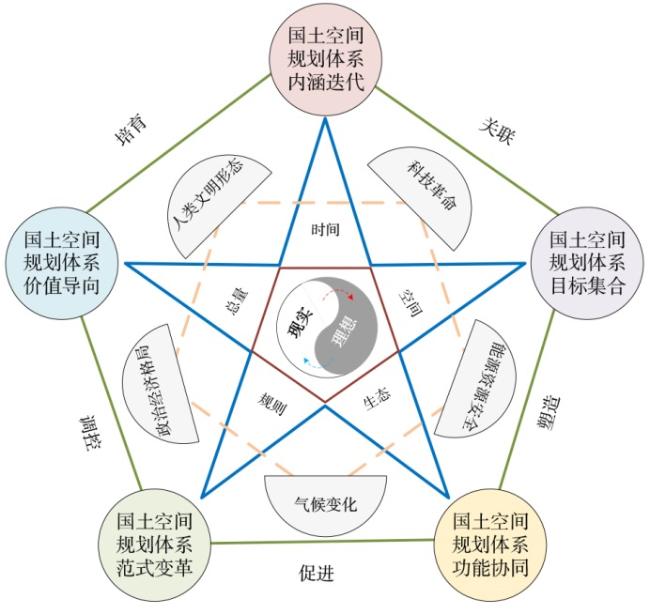
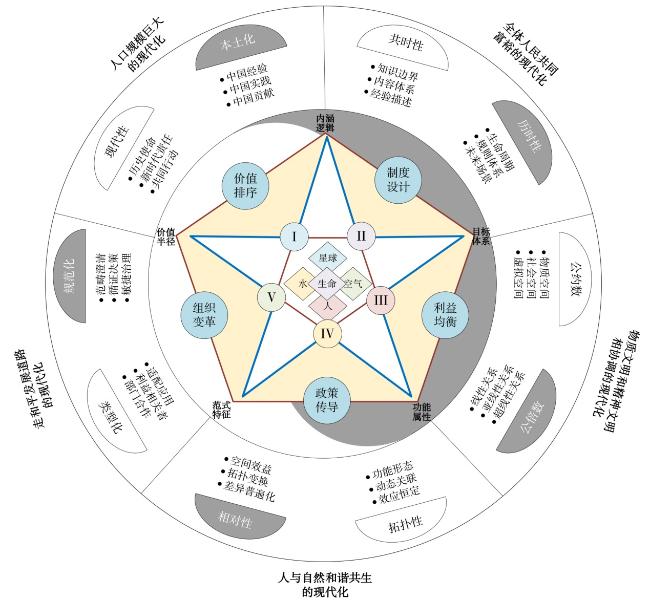
Based on the essential requirements of Chinese path to modernization, this paper explores the basic logic and innovative path of territorial spatial planning, and provides references for building an inclusive, sustainable, and resilient territorial spatial planning system. It uses the theoretical analysis and inductive-deductive method to discuss the basic relationship and innovation path of the territorial spatial planning system in the future. The research results are as follows: 1) The territorial spatial planning in the process of Chinese path to modernization needs to coordinate five basic relationships: the relationship between human civilization form and planning value orientation, the relationship between energy and resource security and planning goal setting, the relationship between sci-technological revolution and planning connotation iteration, the relationship between climate change and planning function synergy, and the relationship between political and economic pattern and planning paradigm change. 2) The innovation path of a future-oriented territorial spatial planning system needs to coordinate five innovative paths, including "modernity" and "localization" of value radius, "common divisor" and "common multiple" of the target system, "synchronic" and "diachrony" of the connotation logic, "topology" and "relativity" of the functional attributes, "typification" and "normalization" of paradigm features. 3) There is an urgent need to grasp three new directions in the development of the territorial spatial planning system to meet future trends. The first is the theoretical construction of the future territorial spatial planning system in the context of Chinese path to modernization. The second is the practical exploration of the future territorial spatial planning system for the modernization of the national governance system and governance capacity. The third is the scientific limits of the future territorial spatial planning system, the relationship between subject and object, the expansion of spatial principles in different application scenarios, technical innovation, and conceptual transformation.
NIU Shandong , LYU Xiao , GU Guozheng . Future Scenarios of Territorial Spatial Planning System for Chinese Path to Modernization: Basic Relationships and Innovative Path[J]. Economic geography, 2024 , 44(12) : 153 -164 . DOI: 10.15957/j.cnki.jjdl.2024.12.016
| [1] |
庄少勤. 新时代的空间规划逻辑[J]. 中国土地, 2019(1):4-8.
|
| [2] |
吴志强. 国土空间规划原理[M]. 上海: 同济大学出版社, 2022.
|
| [3] |
吴次芳, 吴宇哲, 彭毅, 等. 空间治理[M]. 北京: 地质地出版社, 2022.
|
| [4] |
冯文利, 张辉, 陈美景, 等. 数字生态文明时代国土空间规划转型[J]. 中国土地科学, 2024, 38(3):1-9.
|
| [5] |
董祚继. 新时代国土空间规划的十大关系[J]. 资源科学, 2019, 41(9):1589-1599.
|
| [6] |
段进, 张庭伟, 尹稚, 等. “中国式城乡现代化;内涵、特征与发展路径”学术笔谈[J]. 城市规划学刊, 2023, 275(1):1-10.
|
| [7] |
|
| [8] |
严金明, 迪力沙提·亚库甫, 张东昇. 国土空间规划法的立法逻辑与立法框架[J]. 资源科学, 2019, 41(9):1600-1609.
|
| [9] |
黄贤金. 构建新时代国土空间规划学科体系[J]. 中国土地科学, 2020, 34(12):105-110.
|
| [10] |
陈明星, 梁龙武, 王振波, 等. 美丽中国与国土空间规划关系的地理学思考[J]. 地理学报, 2019, 74(12):2467-2481.
|
| [11] |
岳文泽, 王田雨. 资源环境承载力评价与国土空间规划的逻辑问题[J]. 中国土地科学, 2019, 33(3):1-8.
|
| [12] |
|
| [13] |
林坚, 赵晔. 国土空间治理与央地协同:基于“区域—要素”统筹的视角[J]. 中国人民大学学报, 2022, 36(5):36-48.
|
| [14] |
欧名豪, 丁冠乔, 郭杰, 等. 国土空间规划的多目标协同治理机制[J]. 中国土地科学, 2020, 34(5):8-17.
|
| [15] |
|
| [16] |
谭荣. 价值、利益和产权:百年土地产权制度变迁的治理逻辑[J]. 中国土地科学, 2021, 35(12):1-10.
|
| [17] |
王凯, 蒋国翔, 罗彦, 等. 适应气候变化的国土空间规划应对总体思路研究[J]. 规划师, 2023, 39(2):5-10.
|
| [18] |
|
| [19] |
鲍海君, 王成超, 张瑶瑶, 等. 国土空间规划赋能共同富裕:机理解析与地方实践[J]. 中国土地科学, 2022, 36(8):10-18.
|
| [20] |
杨庆媛, 罗奎, 劳昕. 基于地理学视角的国际空间规划嬗变与启示[J]. 地理学报, 2020, 75(6):1223-1236.
|
| [21] |
谷玮, 王梦婧, 吴次芳, 等. 统筹发展与安全战略下的国土空间规划:范式、学理和实践逻辑的反思与回应[J]. 中国土地科学, 2022, 36(6):11-20.
|
| [22] |
|
| [23] |
戈大专, 陆玉麒. 面向国土空间规划的乡村空间治理机制与路径[J]. 地理学报, 2021, 76(6):1422-1437.
|
| [24] |
|
| [25] |
吴志强, 张悦, 陈天, 等. “面向未来:规划学科与规划教育创新”学术笔谈[J]. 城市规划学刊, 2022, 66(5):1-16.
|
| [26] |
张尚武. 国土空间规划编制技术体系:顶层架构与关键突破[J]. 城市规划学刊, 2022(5):45-50.
|
| [27] |
阳建强. 走向持续的城市更新——基于价值取向与复杂系统的理性思考[J]. 城市规划, 2018, 42(6):68-78.
|
| [28] |
黄亚平, 郑有旭, 谭江迪, 等. 空间生产语境下的村镇聚落体系认知与规划路径[J]. 城市规划学刊, 2022(3):29-36.
|
| [29] |
张京祥, 林怀策, 陈浩. 中国空间规划体系40年的变迁与改革[J]. 经济地理, 2018, 38(7):1-6.
|
| [30] |
|
| [31] |
陈璐, 周剑云, 李建军, 等. 从管制到规制:详细规划的法治化方式探究[J]. 城市规划, 2023, 47(4):4-14.
|
| [32] |
武廷海. 国土空间规划体系中的城市规划初论[J]. 城市规划, 2019, 43(8):9-17.
|
| [33] |
陆大道. 人文与经济地理学如何响应“中国式现代化”的要求[J]. 经济地理, 2023, 43(3):1-5.
|
| [34] |
孙施文. 国土空间规划的知识基础及其结构[J]. 城市规划学刊, 2020, 64(6):11-18.
|
| [35] |
石楠. 城乡规划学学科研究与规划知识体系[J]. 城市规划, 2021, 45(2):9-22.
|
/
| 〈 |
|
〉 |