


Digital Infrastructure and the Spatial Restructuring of Chinese Cities
Received date: 2023-12-11
Revised date: 2024-03-03
Online published: 2024-09-12
Digital technology has injected new power into China's economic development,and the high-quality urban development driven by the digital economy is inseparable from the support of digital infrastructure. Based on the panel data of 263 cities at prefecture level and above from 2002 to 2020,this paper discusses the influence of digital infrastructure development level on the dynamic change of urban spatial structure,the site selection heterogeneity of enterprises in different industries and its influencing factors from the dimensions of central population density,population density gradient and multi-center index. The findings indicate that: 1) The enhancement of digital infrastructure leads to a rise in population density in central urban areas. This manifests as intensified population density near the central business district (CBD),while the rate of population density decline with distance is accelerated,suggesting that the expansion of digital infrastructure brings a stronger cohesion force to city centers,making these areas denser. 2) Although the core area is more compact,cities are developing towards multi-centricity,demonstrating the growth and spread of emerging sub-centers. 3) Subways,as an efficient and convenient public transportation method,have facilitated dispersion to a certain extent,but this has not fundamentally altered the overall trend of aggregation towards city centers. Cities should develop policies tailored to local conditions to alleviate pressure in central areas and promote the coordinated development of all urban regions.
LIU Xiuyan , WANG Yuxin . Digital Infrastructure and the Spatial Restructuring of Chinese Cities[J]. Economic geography, 2024 , 44(4) : 55 -63 . DOI: 10.15957/j.cnki.jjdl.2024.04.006
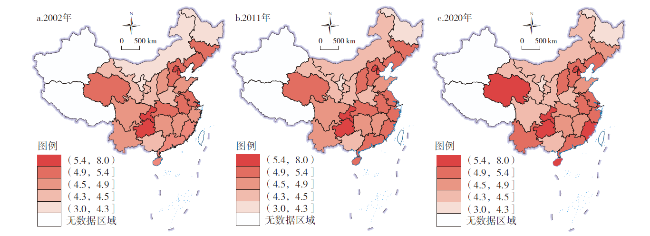
图2 中国各省平均人口密度梯度变化趋势Fig.2 Trends in population density gradient changes of provinces |
表2 工具变量回归结果Tab.2 Instrumental variable regression results |
| (1) | (2) | (3) | (4) | (5) | (6) | (7) | (8) | (9) | |
|---|---|---|---|---|---|---|---|---|---|
| CPD | PDG | Polyc | |||||||
| Lag_DigInf | FT_isbd | PO_isbd | Lag_DigInf | FT_isbd | PO_isbd | ||||
| Lag_DigInf | 0.949*** | -0.260*** | 0.850*** | ||||||
| (0.170) | (0.0512) | (0.165) | |||||||
| FT_isbd | 6.017*** | -1.516*** | 0.906* | ||||||
| (1.057) | (0.274) | (0.478) | |||||||
| PO_isbd | 7.441*** | -1.980*** | 1.016 | ||||||
| (1.356) | (0.374) | (0.625) | |||||||
| Controls | YES | YES | YES | YES | YES | YES | YES | YES | YES |
| City FE | YES | YES | YES | YES | YES | YES | YES | YES | YES |
| Year FE | YES | YES | YES | YES | YES | YES | YES | YES | YES |
| N | 4809 | 3928 | 3928 | 4809 | 3928 | 3928 | 4554 | 3721 | 3721 |
| R2 | 0.995 | 0.986 | 0.980 | 0.995 | 0.991 | 0.987 | 0.689 | 0.695 | 0.693 |
表3 机制检验Tab.3 Mechanism test results |
| (1) | (2) | (3) | (4) | (5) | (6) | (7) | (8) | (9) | (10) | |
|---|---|---|---|---|---|---|---|---|---|---|
| Dist | Dist | Dist | Dist | 住宿和餐饮业 | 住宿和餐饮业 | 制造业 | 制造业 | 批发和零售业 | 批发和零售业 | |
| DigInf | -0.971** | -0.129 | 0.0570 | -0.296 | -0.295 | 0.119 | 0.0718 | |||
| (0.459) | (0.239) | (0.205) | (0.274) | (0.262) | (0.118) | (0.131) | ||||
| FT_isbd | -0.105** | |||||||||
| (0.0501) | ||||||||||
| FT_isbd_ismetro | -0.0330** | |||||||||
| (0.0148) | ||||||||||
| PO_isbd_ismetro | -0.0134** | |||||||||
| (0.00571) | ||||||||||
| DigInf_ismetro | -0.105*** | 0.0266 | ||||||||
| (0.0390) | -0.000428 | (0.0251) | ||||||||
| Controls | YES | YES | YES | YES | YES | YES | YES | YES | YES | YES |
| City FE | YES | YES | YES | YES | YES | YES | YES | YES | YES | YES |
| Year FE | YES | YES | YES | YES | YES | YES | YES | YES | YES | YES |
| N | 5076 | 5074 | 5076 | 5076 | 5076 | 5076 | 5075 | 5075 | 5076 | 5076 |
| R2 | 0.951 | 0.951 | 0.951 | 0.951 | 0.904 | 0.904 | 0.882 | 0.882 | 0.965 | 0.965 |
表4 数字基础设施与城市规模及产业结构的交互效应Tab.4 The interaction effects of digital infrastructure with city scale and industrial structure |
| (1) Dist | (2) Dist | (3) Dist | (4) Dist | (5) Dist | |
|---|---|---|---|---|---|
| DigInf_scale | 0.0477(0.0729) | ||||
| DigInf_lndp | 0.184*(0.108) | ||||
| DigInf_primary | -0.00955(0.0268) | ||||
| DigInf_secondary | 0.124**(0.0540) | ||||
| DigInf_tertiary | -0.171**(0.0748) | ||||
| Controls | YES | YES | YES | YES | YES |
| City FE | YES | YES | YES | YES | YES |
| Year FE | YES | YES | YES | YES | YES |
| N | 5071 | 5071 | 5076 | 5076 | 5076 |
| R2 | 0.940 | 0.941 | 0.941 | 0.941 | 0.941 |
| [1] |
邓慧慧, 刘宇佳, 王强. 中国数字技术城市网络的空间结构研究——兼论网络型城市群建设[J]. 中国工业经济, 2022(9):121-139.
|
| [2] |
|
| [3] |
姚常成, 宋冬林. 数字经济与产业空间布局重塑:均衡还是极化[J]. 2023, 44(6):69-87.
|
| [4] |
安同良, 杨晨. 互联网重塑中国经济地理格局:微观机制与宏观效应[J]. 经济研究, 2020, 55(2):4-19.
|
| [5] |
吴嘉贤, 刘修岩. 空间经济视角下地铁建设与城市空间结构演化[J]. 现代经济探讨, 2023(11):85-100.
|
| [6] |
|
| [7] |
|
| [8] |
|
| [9] |
|
| [10] |
|
| [11] |
|
| [12] |
|
| [13] |
|
| [14] |
|
| [15] |
|
| [16] |
|
| [17] |
|
| [18] |
|
| [19] |
|
| [20] |
|
| [21] |
吴思栩, 李杰伟. “数字经济”时代城市的未来——互联网对中国城市生产性服务业集聚的影响研究[J]. 经济学(季刊), 2024, 24(2):431-447.
|
| [22] |
刘一丝. 数字经济背景下城市空间演化与治理路径探析[J]. 中州学刊, 2023, 22(6):21-27.
|
| [23] |
刘杰, 王胜华. 数字经济对增值税地区分配的影响研究[J]. 经济经纬, 2023, 40(4):126-137.
|
| [24] |
|
| [25] |
王峤, 刘修岩, 李迎成. 空间结构、 城市规模与中国城市的创新绩效[J]. 中国工业经济, 2021(5):114-132.
|
| [26] |
宋敬, 陈良华, 叶涛. 数字化转型对企业绿色创新的影响效应研究[J]. 软科学, 2023, 37(12):109-114.
|
| [27] |
|
/
| 〈 |
|
〉 |