


Multidimensional Evaluation of Innovation Development Ability in Hunan Agricultural Science and Technology Parks
Received date: 2023-08-25
Revised date: 2023-11-02
Online published: 2024-06-03
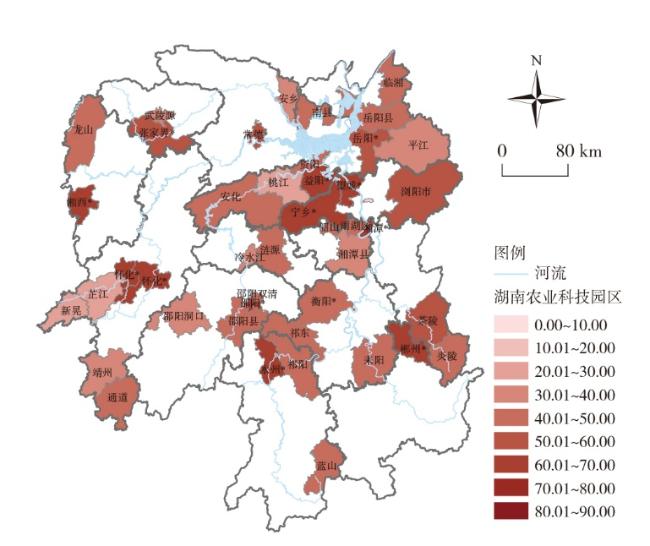
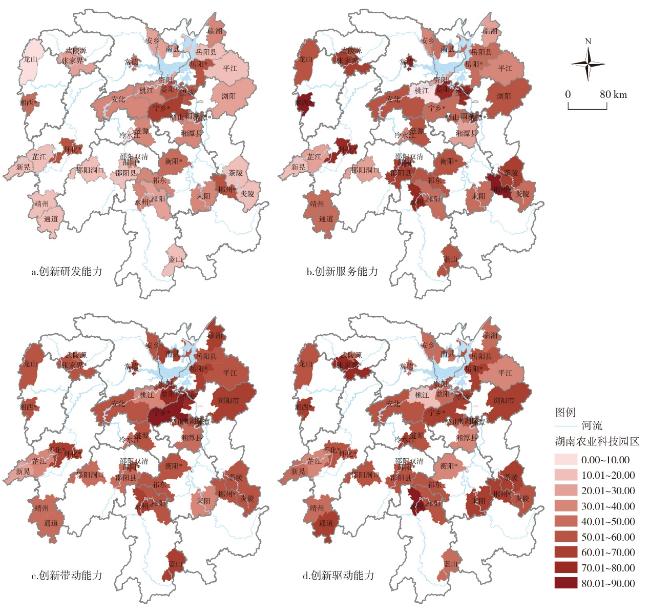
This article constructs an evaluation index system for the innovation development ability of Hunan agricultural science and technology parks from four aspects which are the innovation research and development ability,the innovation service ability, the innovation-driven ability,and the innovation-propelled ability. Based on the multiple factor weighted comprehensive evaluation method,GIS spatial analysis method, and K-cluster analysis method,this paper analyzes the spatial distribution pattern and classification of the innovation development ability of 42 agricultural science and technology parks in Hunan Province. The results show that: 1) The innovation development ability of Hunan agricultural science and technology parks shows a spatial differentiation pattern of "one core and multiple points" with Changsha-Zhuzhou-Xiangtan as the core and national agricultural science and technology parks as the scattered points. It has strong innovation-driven ability and relatively weak innovation research and development ability as a whole. 2) The 42 agricultural science and technology parks in Hunan Province can be divided into three categories: innovation leading type,innovation stable type and innovation starting type. 13 national agricultural science and technology parks are the innovation leading type,21 agricultural science and technology parks such as Liuyang and Qidong are the innovation stable type,and 8 agricultural science and technology parks such as Linxiang and Nanxian are the innovation starting type. Referring to the "333" layout of national agricultural science and technology parks,Hunan Province should increase the cultivation efforts of agricultural science and technology parks,establish a hierarchical system for agricultural science and technology parks,enhance the independent innovation capability of agricultural science and technology parks,create agricultural industry clusters,and establish a normalized monitoring and evaluation mechanism for the innovation development ability of agricultural science and technology parks in the whole province.
LIU Can , LIAO Ting , TAN Liming , LEI Xiaoyu , SHI Lin . Multidimensional Evaluation of Innovation Development Ability in Hunan Agricultural Science and Technology Parks[J]. Economic geography, 2024 , 44(1) : 139 -147 . DOI: 10.15957/j.cnki.jjdl.2024.01.014
表1 农业科技园区创新发展能力评价指标体系Tab.1 Evaluation index system of innovation development ability for Hunan agricultural science and technology parks |
| 一级指标 | 二级指标 | 权重 | 指标说明 |
|---|---|---|---|
| 创新研发能力 | 园区企业R&D经费支出占 营业收入的比重 | 0.063 | |
| 省级及以上研发平台当量数 | 0.068 | 考虑不同级别研发平台的实力差距,采用“当量”的方式,即1个国家级研发平台按3个省级研发平台计算 | |
| 有效专利数 | 0.063 | ||
| 省级及以上审定新品种(系) | 0.056 | ||
| 创新服务能力 | 园区科普能力 | 0.056 | 该指标通过采集农科园年度举办的各类培训会次数 |
| 省级及以上孵化载体当量数 | 0.068 | 包括科技企业孵化器、众创空间、星创天地等 | |
| 科技服务专家 | 0.063 | 采集农科园科技特派员、“三区”人才数进行量化测算 | |
| 科技推广能力 | 0.063 | 农科园年度引进与推广的品种、技术、设施数量进行测算 | |
| 创新带动能力 | 园区就业人员数 | 0.050 | |
| 园区农业企业当量数 | 0.055 | 农业/林业产业化龙头企业、高新技术企业、科技型中小企业、上市企业 | |
| “三产”融合度 | 0.050 | 农科园第二三产业产值占总产值的比例 | |
| 园区农民增收情况 | 0.050 | 农民年度收入的增长率来度量 | |
| 园区投入产出效益 | 0.045 | 农科园总产值与总投入资金的比值 | |
| 创新驱动能力 | 园区就业人员增长率 | 0.050 | |
| 企业增长率 | 0.045 | ||
| 产值增长率 | 0.055 | ||
| 信息化建设水平 | 0.050 | 农科园搭建农业信息化平台、链接相关专业网络信息资源等信息化资源建设情况,该指标结合专家评价得分进行量化测算 | |
| 政策支持力度 | 0.050 | 结合政策数量、专家评价得分情况进行量化测算 |
表2 湖南省农科园创新发展能力得分表Tab.2 Score table of innovation development ability of Hunan agricultural science and technology parks |
| 简称 | 综合得分 | 简称 | 综合得分 | |
|---|---|---|---|---|
| 望城* | 67.52 | 涟源 | 44.52 | |
| 宁乡* | 65.89 | 祁阳 | 43.43 | |
| 益阳* | 64.37 | 临湘 | 42.10 | |
| 郴州* | 63.97 | 南县 | 42.09 | |
| 永州* | 63.20 | 岳阳县 | 41.48 | |
| 怀化* | 63.02 | 双清 | 41.20 | |
| 邵阳* | 62.60 | 炎陵 | 40.98 | |
| 湘西* | 62.35 | 雨湖 | 40.91 | |
| 湘潭* | 61.40 | 龙山 | 40.49 | |
| 常德* | 60.23 | 安乡 | 40.02 | |
| 岳阳* | 54.53 | 通道 | 39.06 | |
| 张家界* | 53.41 | 资阳 | 37.92 | |
| 浏阳 | 51.47 | 靖州 | 37.37 | |
| 祁东 | 49.95 | 冷水江 | 36.30 | |
| 茶陵 | 49.15 | 武陵源 | 36.17 | |
| 安化 | 48.32 | 平江 | 35.28 | |
| 耒阳 | 47.82 | 湘潭县 | 34.87 | |
| 韶山 | 47.15 | 洞口 | 34.11 | |
| 衡阳* | 47.06 | 芷江 | 26.11 | |
| 蓝山 | 45.02 | 新晃 | 25.96 | |
| 邵阳县 | 44.71 | 桃江 | 22.89 |

表3 湖南省农科园创新发展能力评价K值聚类分析结果Tab.3 Cluster results of K-value evaluation of innovation development ability in Hunan agricultural science and technology parks |
| 类型 | 农科园代码 | 备注 |
|---|---|---|
| 创新发展引领 | 望城、宁乡、益阳、郴州、永州、怀化、邵阳、湘西、湘潭、常德、岳阳、张家界、衡阳 | 13家农科园,均为国家级农科园 |
| 创新发展稳健 | 浏阳、祁东、茶陵、安化、耒阳、韶山、蓝山、邵阳县、涟源、祁阳、岳阳县、双清、炎陵、雨湖、龙山、通道、资阳、冷水江、武陵源、洞口、新晃 | 21家农科园 |
| 创新发展起步 | 临湘、南县、安乡、靖州、平江、湘潭县、芷江、桃江 | 8家农科园 |
| [1] |
朱隽, 常钦. 强国必先强农农强方能国强[N]. 人民日报, 2023-02-16(02).
|
| [2] |
习近平. 高举中国特色社会主义伟大旗帜为全面建设社会主义现代化国家而团结奋斗[N]. 人民日报, 2022-10-26(01).
|
| [3] |
|
| [4] |
邹建国. 农业供应链金融视角的农户信贷约束缓解效应研究——来自湖南农户的经验证据[J]. 财经理论与实践, 2023, 44(3):35-42.
|
| [5] |
洪名勇, 王极, 田梦婕. 农民专业合作社对农户消费结构升级的影响[J]. 消费经济, 2023, 39(5):90-101.
|
| [6] |
包晓斌. 乡村生态振兴:总体目标、重点任务与推进对策[J]. 湖湘论坛, 2023, 36(5):45-55.
|
| [7] |
陈阜, 王喆. 我国农业科技园区的特征与发展方向[J]. 农业现代化研究, 2002(2):133-136.
|
| [8] |
芮正云. 我国农业科技园区功能定位及其效应研究——基于江苏白马国家农业科技园发展的认识与思考[J]. 安徽农业大学学报:社会科学版, 2014, 23(1):11-16.
|
| [9] |
成福伟. 发达国家现代农业园区的发展模式及借鉴[J]. 世界农业, 2017(1):13-17.
|
| [10] |
白冰洁, 高美玲. 日本农业现代化发展模式和经验研究[J]. 乡村科技, 2017(15):23.
|
| [11] |
申秀清, 修长柏. 借鉴国外经验发展我国农业科技园区[J]. 现代经济探讨, 2012(11):78-81.
|
| [12] |
蒋和平, 崔凯. 农业科技园区:成效、模式与示范重点[J]. 农业经济问题, 2009(1):9-14.
|
| [13] |
李小璇. 我国现代农业科技园区发展模式研究[D]. 福州: 福建师范大学, 2014.
|
| [14] |
袁波, 高凯, 周鹏飞, 等. 广东、浙江现代农业科技园建设对江苏的启示[J]. 江苏科技信息, 2022, 39(29):1-4,19.
|
| [15] |
艾洪娟, 孟召娣, 蒋和平. 国家农业科技园区发展成效与模式研究[J]. 中国农业科技导报, 2021, 23(2):1-8.
|
| [16] |
吴圣, 吴永常, 陈学渊. 我国农业科技园区发展:阶段演变、面临问题和路径探讨[J]. 中国农业科技导报, 2019, 21(12):1-7.
|
| [17] |
国家农业科技园区创新能力评价课题组. 国家创新调查制度系列报告——国家农业科技园区创新能力评价报告 2015[M]. 北京: 科学技术文献出版社, 2016.
|
| [18] |
贾敬敦. 三产融合全产业链视角下的农业园区[J]. 中国农村科技, 2016(8):46-49.
|
| [19] |
刘丽红, 李瑾. 我国农业科技园区创新能力评价指标及模型研究[J]. 江苏农业科学, 2015, 43(8):451-453.
|
| [20] |
夏岩磊. 基于因子分析的农业科技园区创新能力评价——以安徽省国家级园区为例[J]. 江苏农业科学, 2018, 46(5):303-307.
|
| [21] |
雷玲, 脱潇潇. 基于供给侧结构性改革的陕西现代农业科技园区综合创新发展能力评价——基于熵权法与TOPSIS相结合的模型[J]. 科技管理研究, 2019, 39(3):114-120.
|
| [22] |
钱政成, 王兆华. 山东省农业科技园区创新能力评价研究——基于层次分析法和障碍度模型[J]. 山东农业科学, 2021, 53(11):144-150.
|
| [23] |
雷玲, 陈悦. 杨凌农业科技示范园区创新能力评价[J]. 中国农业资源与区划, 2018, 39(8):211-217.
|
| [24] |
谢玲红, 吕开宇, 夏英. 乡村振兴视角下农业科技园区绩效评价及提升方向——以106个国家农业科技园区为例[J]. 中国科技论坛, 2019(9):162-172.
|
| [25] |
夏岩磊. 长三角农业科技园区建设成效多维评价[J]. 经济地理, 2018, 38(4):139-146..
|
| [26] |
卢召艳, 黎红梅, 魏晓, 等. 城市群核心区域科技创新潜力评价及影响因素——以长株潭城市群核心区为例[J]. 经济地理, 2022, 42(4):141-149.
|
| [27] |
韩政, 程钰, 刘娜. 科技创新对中国沿海地区产业生态化的影响研究[J]. 湖南师范大学自然科学学报, 2021, 44(4):81-90.
|
| [28] |
侯松, 甄延临, 曹秀婷, 等. 高质量发展背景下城市群治理评价体系构建及应用—以长三角城市群为例[J]. 经济地理, 2022, 42(2):35-44.
|
| [29] |
毕亮亮, 施祖麟. 长三角城市科技创新能力评价及“区域科技创新圈”的构建——基于因子分析与聚类分析模型的初探[J]. 经济地理, 2008, 28(6):946-951,954.
|
| [30] |
焦贝贝, 张治河, 刘海猛, 等. 乡村振兴战略下欠发达地区农村创新能力评价——以甘肃省86个县级行政单元为例[J]. 经济地理, 2020, 40(1):132-139,172.
|
| [31] |
陈慧卿, 曾福生. 湖南省农业农村现代化发展水平测度及其区域差异[J]. 经济地理, 2022, 42(11):185-194.
|
| [32] |
曹执令. 湖南省区域农业竞争力比较研究[J]. 经济地理, 2012, 32(2):139-142.
|
| [33] |
中华人民共和国科学技术部. 国务院新闻办新闻发布会文字实录[EB/OL]. https://www.most.gov.cn/xwzx/twzb/fbh19120401/twbbwzsl/201912/t20191204_150294.html,2019-12-04.
|
/
| 〈 |
|
〉 |